
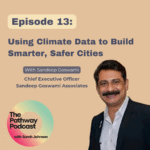




In this episode, Sarah sits down with Sandeep Goswami, founder of Sandeep Goswami Associates, to explore how his firm’s cutting-edge climate data tool is helping businesses and cities avoid catastrophe, build resilient infrastructure, and turn sustainability into long-term value.
About Our Guest
Sandeep Goswami is the Principal of Sandeep Goswami Associates (SGA), a consultancy focused on helping businesses adopt sustainable practices and innovations that align with the UN Sustainable Development Goals. His firm provides data-driven sustainability services, including climate risk forecasting, ESG and SDG integration, and sustainable infrastructure design.
Sandeep is the creator of Climate Science As A Sustainability Service (CSAASS), a proprietary assessment and forecasting tool. Through partnerships with EU-based ESG and meteorology firms, CSAASS aggregates satellite imagery, climate models, historical disaster records, and geospatial data to help companies and cities identify climate and disaster risks. The tool allows clients to map risks with high precision and supports long-term planning to prevent financial and environmental loss.
In addition to consulting, Sandeep is actively developing climate-resilient technologies through his SG Lab. His innovations include human-powered flooring tiles, vehicle-powered tiles, bio-walls that absorb car exhaust and smog, micro-hydropower systems that capture energy from gravity-fed water, and micro wind turbines designed for vehicles, railways, and building balconies. He is also working on a tabletop air purification prototype and contributing to the design of integrated, climate-resilient smart cities.
Through his work, Sandeep aims to make sustainable technologies more accessible, especially in low-income and vulnerable communities, and to help both public and private sector stakeholders transition toward more resilient and equitable futures.
Transcript
Sandeep Goswami 0:00
So let’s say, if these cities are not investing in sustainable infrastructure planning, and the casting that predicts a significant escalation in climate related disaster, infrastructure failures, economic losses, public health crisis, and regulatory risk over the next five to 50 years, if that is going to happen because we are already seeing this happen.
Proactive, data-driven planning is essential to mitigate this risk and to ensure urban resilience and economic stability as well as social well being. So if you would have read the latest reports, we are talking about the whole weather cycle — the kind of flooding we are talking about is changing by 2028 because the temperatures are really going upwards and that’s one big disaster.
So let’s see what happens when escalating climate and disasters – so weather events, cities will face more frequent and severe floods.
Sarah Johnson 0:54
Welcome to the Pathway Podcast. I’m your host, Sarah Johnson, and thank you for joining us for this episode. Pathway to Tomorrow is a nonprofit with initiatives in housing, environmental conservation, and water security. In this podcast series, we engage with leaders working on solving some of the world’s most challenging problems by exploring innovative solutions being implemented by leading NGOs, non-profits think tanks, companies, and institutions focused on issues like homelessness, environmental conservation, climate change, and water security.
Our guest today is Sandeep Goswami. Sandeep is a serial entrepreneur, sustainability advocate, and climate science expert. He is the founder of Sandeep Goswami Associates, where he leads climate-focused collaborations with organizations like Meteoblue AG and ESG Matters AsP.
Through these collaborations, Sandeep helped develop CSAASS a proprietary multi-dimensional tool that integrates climate risk assessment, disaster risk resilient design, and ESG reporting.
Sarah Johnson 2:03
This innovative platform equips businesses and governments with actionable insights to assess climate risks — and implement effective strategies for climate adaptation, resilience, and mitigation. Throughout his career, Sandeep has founded and advised several pioneering ventures in sustainability. These include the firm Fountainhead II, an architecture and interior design firm specializing in green building solutions, Dadichi, the developers of the UVC mop and remote rescue robot that enhanced safety during the COVID-19 pandemic, Thermaissance, the makers of an FDA-certified self-sanitizing textile technology, and Eco-Ater, creator of a vertical axis wind turbine that delivers efficient renewable energy solutions. Sandeep’s inventions have garnered national and international recognition. He has been invited to present his work to the Prime Minister of India, Narendra Modi, and was recognized by the United Nations Industrial Development Organization for developing a pandemic-era social distancing robot. This project was executed in collaboration with Combat Robotics and India’s Department of Science and Technology.
Sarah Johnson 3:12
Today, Sandeep continues to influence sustainable urban development across India and the world. He works closely with governments, corporations and international agencies to bring climate innovations to market, focusing on renewable energy, carbon credit systems and resilient infrastructure using advanced materials and eco friendly technologies. Sandeep, it’s such a pleasure to have you on today.
Sarah Johnson 3:30
Sandeep, it’s great to have you on today. Thank you for taking the time to speak with us.
Sandeep Goswami 3:36
Thank you, Sarah, for having me on your prestigious program.
Sarah Johnson 3:39
So to start us off, Sandeep, you’re currently a principal at Sandeep Goswami Associates, a consultancy focused on helping businesses to adopt sustainable practices and innovations that help align them with the UNSDGs. Can you tell us more about your career and some of the clients you’ve advised whose practices and results stand out as models for the inherent business value of investing in sustainability?
Sandeep Goswami 4:03
Sure, Sarah. So, while we cannot name many of the blue chip companies which we have worked for, other than those listed in my website — which you can visit. However, to give an example of what we have achieved, is that we have saved one company in India from buying into a 35-acre land parcel next to a river. As via simulation, we could prove that within 10 years, the meandering of the river would pose severe flood risk to five acres of that plot, and any asset built on it would be in grave danger. This saved the company from sure disaster and loss.
Sandeep Goswami 4:41
We were also able to identify land risk and another piece of real estate, which not only helped the real estate developer to negotiate a better price to purchase the land — as he would have invested in cutting off the whole HELOC — but prevented catastrophe. Had the residential business and business tower been built there — over an unstable hill — I am sure the listeners can gauge the huge financial reputation and, most importantly, loss of livelihood that has been prevented. We have forewarned the textile mill that due to changing in the weather pattern, their water supply to their industry is getting affected, and they have already started to take preventive measures, so that by 2030 when the problem would be apparent to all, they would have already had their own stock of water.
Sarah Johnson 5:33
Thank you for sharing those examples, Sandeep. They’re great examples of how data-driven sustainability consulting can safeguard not just investments, as you said, but lives and livelihoods. So I’d like to dive a little deeper into your firm and its offerings. Specifically, your firm offers a proprietary forecasting tool that’s central to doing this work. Can you tell us more about Climate Science As A Sustainability Service — or CSAASS — your proprietary assessment and forecasting tool, and how companies have leveraged this offering to manage climate and disaster risks, advance their sustainability goals, and attract investment.
Sandeep Goswami 6:12
Sure, Sarah. So the CSAASS or, as I call it, cash — because people understand cash or money better — it saves money. So we have this inbuilt capacity through our EU-based ESG and meteorology firms — one with a deep knowledge in creating the Paris Agreement, and other with a legendary precision in the prediction of weather events to provide climate risk impact analysis, both short and long term. When applied to building an infrastructure, accurate prediction of climate change can make the difference between risk and opportunities for businesses — now and in the future. And we can provide our cash services to all. So we are open to providing our resilient and sustainable design surface around the world, and we aim to create climate resilient, integrated, smart cities on private land banks of 100-acre parcels, usually — or more in India. And looking for companies who would like to step up a company township — which would be a great gated community and have the safety of food, energy, water, waste and health. And, as I said, it’s around the world. We can do that in your country, too.
Sarah Johnson 7:21
That’s very exciting, Sandeep. Thank you for sharing more about that. It’s exciting to hear how CASH, you mentioned — I said, CSAASS — CASH is helping companies move from reactive to proactive when it comes to climate resilience. Now, can we talk a little bit more about the science behind it and how you actually gather and interpret the data that makes these insights possible? Your work focuses on providing businesses with actionable insights based on the latest predictive data on climate disaster and other global risks. Can you tell us more about your process for aggregating and analyzing this data and how you use it to inform clients on the most pressing catastrophic risks they can anticipate and prepare for in the next five to 50 years?
Sandeep Goswami 8:05
Okay, so, that’s a lot to explain, but I will try to put them in bulleted points, and try to make it simple. So let’s say — what we try to do is that we — first, we do an aggregation of data from diverse resources. So there is a satellite imagery, then we do climate models. Then, of course, we will definitely take the historical disaster records of that given area. Then we get into real-time monitoring and the geospatial data sets. Then, what we do with that is that we integrate those into a global catastrophic event with over 100 — over 110 — countries including insured and insurable losses, to build a comprehensive risk database.
Sandeep Goswami 8:46
Once we have that comprehensive risk database, we use multi-scale data resolutions. I mean, we can go from a region of 100 kilometer square to a district of 10 kilometer square, to local of one-kilometer square. And we can even make it much more accurate by bringing it at about a one-meter square for precise risk mapping. So when we do this, what we can do is that we can go even underground once.
Sandeep Goswami 9:12
First, we use our satellite imagery to do overground and get the data. Once we understand that there is a risk which we think is a red flag — because we give it a grading that it is a no risk, low risk, medium risk, high risk, or a red flag. So wherever we look that there is a high risk for a red flag, then we use our ground press sensors — the lidars, the sonars, the earth-penetrating radars — and then we really map it all over again to see that what we have seen with our satellite imagery and our, you know, our calculations are actually more, more, more — we confirm that more better, so that when we talk about people and we talk about their risk mapping they know that, yes, the risk they are taking financially is the risk that they can take. That’s how we do that.
Sarah Johnson 10:05
Thank you for sharing more on that, Sandeep. It’s clear that from how you’ve described it that the depth and precision of the cash tool, your proprietary tool, is setting a new standard for long-term planning. With that in mind, I’d love to hear more about the sustainable business practices you’re recommending to clients and how those have helped clients strengthen their triple-bottom line. Can you share examples of the kinds of sustainable business practices that you’ve advised clients to adopt and how these practices have helped improve their triple-bottom line? And for those unfamiliar with this term, we’re referring to the triple-bottom line of profit, people, and planet. And as a follow up to that Sandeep, if you could also illuminate for us why you think some businesses are slower to adopt these innovations and sustainable practices when it’s clear that there are so many benefits to them.
Sandeep Goswami 10:53
Yeah, sure. So I will try to put it in simple words, and I will explain them in a way that people understand. So first, let us talk about green buildings and retrofitting. We all understand LEED, BREEAM — that is in the US also, and everywhere else — in India, we also have the same thing. So when we talk about a green building and retrofitting, the first practices we advise clients on design of our retrofit of building, using green materials, energy efficient system, and climate resilient architecture. Now, how does that help? The impact is on profit. It reduces long-term operational cost through energy and water setting. For people, it improves occupant health and productivity by aware via better air quality and comfort. And for the planet, it lowers the carbon footprint and resource consumption.
Sandeep Goswami 11:45
Now, let us take it to the example of climate risk assessment and adaptation. So, what is the practice-implementing cash tool for predictive climate and disaster risk assessment, enabling proactive adaptation strategies — and even mitigation strategies for that? How does it impact the profit? It minimizes financial loss from disasters and enhances the asset value for people. It protects the employees and communities for climate from climate hazards and for the planet. It encourages sustainable land use and disaster resilient infrastructure.
Sandeep Goswami 12:15
Third, we would break down to ESG and SDG integration. So, by practicing, we align businesses towards ESG — as you know, Environmental, Social, and Governance — and SDG is the Sustainable Development Board frameworks. How does that impact in profits? It attracts investment and improves market reputation for people, it promotes fair labor, diversity, and community engagement. And again, for the planet, it drives responsible resource management and emission.
Sandeep Goswami 12:43
Fourth, how we would look at it, is digital monetary reporting. In practice, using digital tools for real-time monitoring of energy emissions — and resource use — helps the impact of profit by identifying inefficiencies and cost-saving opportunities for people; it enhances the transparency and accountability for the planet; it supports continuous improvement in sustainability performance.
Sandeep Goswami 13:08
Now, your question was why some businesses are slower to adopt. First, it is that they perceive that there’s a high cost upfront. Many businesses focus on short-term expenses rather than long-term savings and risk reduction. So that is one of the problems which they have, and this is which, which — I will put it as first.
Sandeep Goswami 13:30
The second is the lack of awareness and expertise, you know. There’s a limited understanding to climate risk, because what we — to the common people, the language, the parlances that are used, are not brought down to their level where they can understand easily, and available technologies or regulatory requirements are not yet so good that everybody can adopt it.
Sandeep Goswami 13:53
Again, the third is the regulatory and market uncertainty. It is unclear, and evolving policies that make it difficult to justify investment or sustainability. You know, it all depends on the political mood sometimes — depends on what is the popular culture, or the mood of the people. Governments tend to dilute or, you know, tend to overregulate things, and that’s a problem which people face. Then there is an organization inertia. So resistance to change is, you know, it’s just normal for everybody. If things are going good, why do I change, and why do I go into something which I don’t know? So this is for established business practices. They’re usually more slow to adopt than young or upcoming businesses to any new innovation. So this is the main reason why some businesses are slower to adapt.
Sarah Johnson 14:45
That makes a lot of sense. Thank you for sharing that, Sandeep. Those examples really underscore how sustainability can drive profitability and social impact when they’re implemented with intention. But innovation is also a major part of your work, especially when it comes to future ready infrastructure. Let’s dig into some of the climate resilient technologies your team is pioneering. Can you talk to us about some of the innovations that SGA encourages its clients to adopt that advance climate resiliency in the areas, specifically, of sustainable building and energy efficiency?
Sandeep Goswami 15:19
Sure, Sarah, that’s very — one of my — just close to my heart because of my SGA lab. So, presently I am designing and developing quite a few innovative products that can help common man and save the planet — through energy harvesting flooring, for example. So, we are doing something called the H-PET, or the human powered tiles for public commercial spaces that are highly trafficked. And V-PET, which are vehicle powered tiles.
Sandeep Goswami 15:43
So, how SGA advances in this area, that will save clients on the product and make it more profitable and accessible. These kind of products are already available in the world — we do not really say that we are the pioneers on that. But what we are able to do is that when you’re looking at vulnerable communities or countries with low income groups – they cannot afford such high technology. And that is where we are stepping in — and stepping up — to see whether we can bring this kind of technology to them. So that is the whole idea.
Sandeep Goswami 16:15
Then we are creating something called a bio wall or a breathing wall. So what we are doing is we are using — there are a lot of chemicals which you would have heard of activated charcoal and zeolite and all those kinds of things. So we are trying to create a breathing wall that can absorb the car exhausts, especially when you’re driving into the basements of the building and driving out of that, the fumes really don’t go out and you can even reduce the smoke through that, you know?
Sandeep Goswami 16:42
So, we are now — just as of today, I have created a tabletop version. So, while sitting on your desk, you can have a very nice, beautiful looking, you know, absorbent machine that’s just sitting there, looks beautiful, and it’s actually cleaning the air around your table, your office, or maybe your room, wherever you are. So, that’s — I just did that today.
Sandeep Goswami 17:07
So, then — now we are working on micro-hydro. So, you know, this came up with an idea that we have to pump a lot of water, usually municipal water tanks, which are made at a very high level. And we pump gallons of water through there and then it is coming down by gravity, going to the homes and businesses. So we thought that while — when it is coming down by gravity, why can’t I use and create micro-hydro, and even tap-up of that energy, therefore reducing the energy consumption of pumping the water up?
Sandeep Goswami 17:38
So that is something we are working on right now. It is on a trial stage. We have created micro-wind turbines. You know, there’s something that you can — if, you know, cars, they move at a high speed, so if you can just put it on top of a car, it’s a vertical wind access turbine. So — it looks neat. You will understand it when you look at, you know, the coaches, the railway coaches, they have a vent on top. So similar to that.
Sandeep Goswami 18:07
And when it rotates, it is creating a power which can keep on giving a turbo power charge to your TV, cars and take it all the more away. For air conditionings in railways, it also helps in reducing the electricity because in trains it is usually the diesel that is converting into electricity. So, that’s again where we work. So, that’s the micro-wind turbine.
Sandeep Goswami 18:36
Yesterday, we thought of creating them as chandeliers that can be hung on terraces or balconies of high-end, high apartments, because there is always a breeze out there. And even to capture that breeze on a 24-7 basis, which can — may not be able to light the whole home, but it can still contribute something to it. So that’s the way SG has done the research and development.
Sandeep Goswami 19:02
And so the next thing which we are doing is: we are designing a climate-resilient, integrated, sustainable, smart city. And when we say that, we use our proprietary tool which can create that on top of our sustainable products. So that the walls we build that breathes in the vehicular pollution, the pavement on which people walk generate electricity, so that every time a car crosses a speed breaker it generates electricity too.
Sandeep Goswami 19:30
People in our buildings get it, communities don’t need to worry about harming the planet as we use innovative technologies to harness even the minor wind and water flow with micro-wind and hydro. Add to that the innovative ideas which our partners bring — our paints on buildings that can reduce the heat-tiling effect of the city, thus reducing the need for district pooling.
Sandeep Goswami 19:52
We also design our designs with floods, droughts, and — most especially now with climate change — wildfire risks which actually also equally damages as floods. So we are totally aligned to the sustainable development goal nine that is industry and innovation 11. So we are truly trying to do the smart cities and communities and industry and innovation merging together. So that’s the whole idea. I hope I was able to explain well.
Sarah Johnson 20:21
So well, Sandeep. But I’m really excited about — you mentioned the prototype for the bio wall that you can put on your desk — I think that’s something everyone is going to want to have in their office, especially with the age, the average age of buildings, office buildings, and even the homes that we live in, and the ventilation issues that we have — in terms of the ability of ventilation system to clean our air — having something like that will be so useful and such a great innovation for our health, so that’s exciting — I’m looking forward to learning where I can purchase mine after this episode. Perhaps you can give us a follow-up link that I can share with our folks.
Sarah Johnson 21:03
But that’s such an inspiring vision of how everyday infrastructure can become part of the climate solution, from roads that generate electricity to buildings that clean the air — I mean, this is really exciting stuff you’re talking about. But I want to understand a little bit more, for our listeners, about what the consequences are of us not taking this route because the exciting things, as you mentioned, there’s — there’s fear around adoption, around the expensive things. But what happens if cities don’t follow suit? What does the future hold? Let’s talk about the risks that lie ahead if sustainable planning continues to be delayed. And I want to specifically talk about this with regard to your CSaaS tool. So, based on insights uncovered by your proprietary CSaaS tool, what are some of the greatest risks that cities can expect to face in the next five to fifty years if they do not invest more heavily in sustainable infrastructure planning?
Sandeep Goswami 21:55
So yeah, this is a very good question and this needs to be answered properly. So let’s say, if these cities are not investing in sustainable infrastructure planning, and the forecasting predicts a significant escalation in climate related disaster, infrastructure failures, economic losses, public health crisis, and regulatory risk over the next five to fifty years, if that is going to happen because we are already seeing this happen.
Sandeep Goswami 22:22
Proactive, data-driven planning is essential to mitigate this risk and ensure urban resilience and economic stability, as well as social well being. So if you would have read the latest reports, we are talking about the whole weather cycle — the kind of flooding we are talking about is changing by 2028 because the temperatures are really going upwards and that’s one big disaster.
Sandeep Goswami 22:46
So let’s see what happens with escalating climate and disasters – so weather events, cities will face more frequent and severe floods. As you know today, Vietnam in this last week; China had a dam burst. So they are having huge severe floods, cyclones. And, as you see, Europe is going through a heat wave, and you are seeing that also in America — droughts —all these things are coming together. So unless you have a predictive model that shows — that is showing a marked increase in both frequency and intensity of these events, you know, and it is leading to a higher economic and human loss. That is the first part.
Sandeep Goswami 23:27
So the second is: what is infrastructure vulnerability and service disruption, what happens? So aging and inadequate infrastructure. For a simple example, Europe was never designed for hot climate. So you usually have fireplaces, but you do not have an air condition to cool the building. Now with the summer heat at 36 degrees centigrade in Switzerland, Italy, can you understand what is happening? Those buildings are — inaccurate infrastructure is there. Without sustainable upgrades, critical systems like power, water, transports are more likely to fail during disasters.
Sandeep Goswami 24:03
And the result is — and the results of prolonged outages, water shortage, and breakdowns of essential services — they will impact the economy directly, right? So the third is economic losses and investment risk. So there will be always a riding cost and people will not want to go and live there. So there is a reduced attractiveness to that place. Because every time there’s a disaster, related damages will increase, insurance costs will increase — that would deter investors. So if you are not investing now, cities with poor sustainability planning face higher operational costs and depreciating asset values, which is not going to help anybody.
Sandeep Goswami 24:40
Add to that the public health and social inequity. It will increase health crisis and it will increase displacement. Vulnerable populations would be disproportionately affected, leading to health emergencies, displacement, and obviously when you’re hungry, you’re angry — it will lead to social unrest. So finally, the poor air quality and lack of green spaces exacerbates the chronic health issues. And last, what happens? Regulatory and compliance risk.
Sandeep Goswami 25:10
So you keep on failing to meet the evolving standards. Inadequate planning will present a non-compliance to ESG, ASG region climate regulations, that would lead to further penalties to the cities. Cities will not receive the funding they require and it will — bring reputational harm. Again, finally leading to investors not wanting to come there. So that is the major thing that would happen.
Sarah Johnson (25:35)
That’s a very scary picture, you’re painting a sobering picture, but it also reinforces the urgency of rethinking how we build and invest in urban spaces. So Sandeep, to wrap up, I’d like for us to talk about how behavior, specifically the behavior of governments, businesses, and individuals, needs to evolve to truly achieve the goals of SDG 9 and SDG 11. So what would you say are some of the behavioral changes that need to take place in the public and private sectors as well as on an individual level to help advance SDG 9, which is to build resilient infrastructure and foster innovation, and SDG 11, which is to make cities inclusive, safe, resilient, and sustainable for all.
Sandeep Goswami (26:18)
Thank you, Sarah, for asking such a beautiful question. And this is very close to my heart. So to make it understandable in an easy format, I will put it in a bulleted format. So let us first take one, public sector behavioral changes. So there needs to be a proactive policy integration. Unless you embed sustainability and resilience criteria in all infrastructure and procurement processes. That’s the first thing that needs.
Sandeep Goswami 26:46
Incentivize innovation. You know, provide grants, tax incentives and regulatory support for green technologies and climate resilient solutions. Then what is another requirement? It may not be for all countries, but somewhere you need to have transparent monitoring and reporting. So implement digital tools for real time tracking of infrastructure performance, emissions and resources, because people would promise you all sorts of things – that was the green building but how is it performing? It’s very important to know that.
Sandeep Goswami 27:18
So then there comes the stakeholder engagement. So you have to foster participatory urban planning, ensuring that the marginalized groups have a voice in the city development. For the second point that comes to my mind is, let’s say private sector behavior changes. That’s very important. So the private sector must add up ESG and SDG frameworks. They must integrate social, environmental and governance at the ESG and the SDG targets into business strategies and operations. It’s true that the top companies are already doing it, but the MSME and others are quite, still have a ways to catch up. And there is a lot even the top conglomerates must do. Then invest in sustainable innovation, you know. These big companies, if they prioritize R &D and development of green materials, energy-efficient systems and climate adaptive technologies, because they have the money to back that up, then they can come to collaborate across sectors.
Sarah Johnson (28:14)
Mm-hmm. Absolutely. Thank you, Sandeep.
Sandeep Goswami (28:18)
Scale sustainable solutions. And the last would be to transfer in disclosures, you know, the regulatory reports on sustainability performance and climate risk stakeholders. Yeah, then individuals, have to come in, civic practitioners have to come in and it’s a continuous learning process, you know, you have to always stay informed about sustainability and innovation. Because that’s when the grassroots understand, once the grassroots understand some of that, everything starts to fall in place.
Sarah Johnson (28:48)
Thank you Sandeep for providing us with that great roadmap. It’s clear and this is a consistent theme I’m seeing when I ask this question of guests like yourself on the podcast that building sustainable cities and industries requires collective action at every level. And these insights you’ve shared give us clear guidance on the direction forward. So thank you so much again for joining us today, Sandeep. It’s been a pleasure to learn more about your work at SGA.
Sandeep Goswami (29:13)
It is a pleasure to be with you, Sarah. I am there always to answer any questions that may arise. Thank you so much.
Sarah Johnson (29:19)
Thank you so much, Sandeep. We’re so grateful for the innovations you’re championing to advance data-driven decision-making and the incorporation of sustainability and climate and disaster risk resilience considerations in planning cities sustainably. And, so excited about these innovations that you’re bringing to market.
To our listeners, thank you for tuning in. And don’t forget to subscribe to the Pathway Podcast to get alerts on new episodes featuring thought leaders working in housing, environmental conservation, climate change, and water security.