
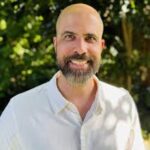




In this episode, Sarah sits down with Dr. Nader Afzalan, Founder of The Triangle and Director of Sustainable Environmental Design at UC Berkeley, to discuss how data-driven program design can improve outcomes in housing, climate resilience, and economic development. Nader shares insights from his work advising governments and building California’s first statewide homelessness data system, highlighting how clear goals, trust-building, and acceptance of trade-offs are essential for successful programs. Together, they explore how designing policies “backwards from outcomes,” using reliable data, and balancing competing priorities can help create more effective and equitable solutions to complex challenges like affordable housing and climate-aligned development.
About Our Guest
Dr. Nader Afzalan is an urban planner, data strategist, and expert in climate resilience, housing, and economic development. He is the Founder of The Triangle, a design and impact advisory firm that helps governments and organizations turn climate and community goals into programs that deliver measurable results. He also serves as Director of Sustainable Environmental Design at the University of California, Berkeley, where he leads interdisciplinary work focused on climate-responsive communities and data-driven program evaluation.
With more than 20 years of experience, Nader has supported over $1 billion in climate and urban transition investments across the United States and internationally. His work includes advising federal and state agencies such as the White House, the U.S. Environmental Protection Agency, the Department of Energy, and the State of California on initiatives related to housing, climate policy, and economic resilience. He also helped design California’s first statewide homelessness data system, providing policymakers with more accurate insights into the scale and nature of homelessness.
Nader’s work focuses on designing programs with clear outcomes, building trust across communities and institutions, and balancing complex priorities to create lasting, measurable impact. Through his leadership in policy, research, and program design, he continues to help shape more resilient, equitable, and climate-ready communities.
Transcript
Nader Afzalan ( 00:00 ):
Every successful program accepts trade-offs. Every single successful program focuses on building trust and understanding of power dynamics, and every successful program has a clear north star.
Sarah Johnson ( 00:20 ):
Welcome to the Pathway podcast. I’m your host, Sarah Johnson, and thank you for joining us for this episode. Pathway to Tomorrow is a nonprofit with initiatives in housing, environmental conservation, and water security.
In this podcast series, we engage with leaders working on solving some of the world’s most challenging problems by exploring innovative solutions being implemented by leading NGOs, nonprofits, think tanks, companies, and institutions focused on issues like homelessness, environmental conservation, climate change, and water security.
Our guest today is Dr. Nader Afzalan, an urban planner, data strategist, and one of the country’s leading experts on the intersection of climate, housing, and economic development. Nader is the founder of The Triangle, a design and impact advisory firm that helps governments and organizations turn climate goals into programs that actually work and prove it with data people trust. He also serves as director of sustainable environmental design at UC Berkeley, where he leads interdisciplinary work at the intersection of climate resilience, the built environment, and program evaluation.
Over the last 20-plus years, Nader has worked across the US, the Middle East, Central America, and China, supporting more than $1 billion in climate and urban transition investments. His career includes advising the White House, the Environmental Protection Agency, the Department of Energy, and the state of California, designing statewide data systems, including California’s first integrated homelessness data system, and publishing more than 30 articles and book chapters on resilience and economic development. From program design and legislative strategy to impact measurement and community-centered climate solutions, Nader’s work bridges policy, data, and on-the-ground implementation in a way few practitioners do.
Nader, thank you so much for being here today.
Nader Afzalan ( 02:21 ):
Thanks, Sarah, for having me.
Sarah Johnson ( 02:24 ):
To start us off, Nader, can you share a bit about your background, from environmental design to your interdisciplinary work across city planning, architecture, climate, and economic development, and how those experiences ultimately shaped the creation of your current firm, The Triangle?
Nader Afzalan ( 02:39 ):
Of course, Sarah, I help organizations, mainly government and nonprofits, to maximize the community benefits and community impact of their programs and policies. So I help them with designing programs and policies and measure the community impact. So I’m mainly focused on potential and actual impact of programs and policies. I’m looking at place-based programs like housing, homelessness, climate, and transportation. And all of this is based on my experience with the state of California and comparing that with some of the other experiences outside of the state, realizing that we often fetishize processes and forget the impact that we are trying to make when we are designing these programs. In California, I firsthand observed that we, for example, allocate $12 billion to address homelessness, and then we pray for it to see something happening on the ground. My work mainly focuses on how we can design programs that get to the things that they really want to get to. So I’m mainly focused on the connection between climate, community, and economy, because I believe if you just forget one of these pieces, everything falls apart, and you don’t get to the impact that you want to get to.
I can talk more and more about the methodology that I have worked on, but just going backward, I grew up like many other kids playing SimCity, which is this amazing urban planning and design game. It got me fascinated about place and cities and how you can design cities that work for people. And I realized early on that we are designing cities for people, we’re not designing cities for buildings, for the infrastructure. Everything is in support of communities. So how can we design programs and policies that really help us get to the community impact that we want to get to?
And I argue that these programs and policies need to have three main components: focus on trust building, be very clear about the outcomes, and also accept trade-offs. We can talk about these in more detail.
Sarah Johnson ( 05:19 ):
Thank you for sharing that, Nader. I want to move on to a recent interview that you did for the Turner Center with Ben Metcalfe, where you examined the key cost drivers of affordable housing production, a huge issue that we’re facing here in the state of California, focusing specifically on the impact of the prevailing wage requirement. You highlight in your interview a key finding of Turner’s research study that prevailing wage requirements increase per-unit development costs by roughly $90,000 per unit.
Can you walk us through that research and what you uncovered, the broader implications of this finding, and why this number has become so influential in California’s housing policy debate?
Nader Afzalan ( 06:00 ):
Yeah, the Turner study, to be very clear, did not argue for or against prevailing wage. It basically quantified its impact. It was saying that, if you are required to pay prevailing wage in the state of California, that requirement is going to add about $90,000 per unit. And this is in addition to what it already costs, which is already pretty high.
So the Turner study basically looked at the impact of the required prevailing wage, which is going to be about $90,000 per unit, on any new affordable housing unit that the state is going to build. And that number was very powerful because it made it very clear that if we are really serious about building more affordable housing, we need to accept the trade-off without accepting the trade-off and saying that we are going to build more affordable housing. By the way, we are going to pay living wages. By the way, we are going to respond to our climate goals. What about responding to creating high-quality jobs, et cetera? Nothing is going to happen. We must accept trade-offs. So I think these kinds of analysis that’s more about data-driven decision-making, help a lot with just bubbling up all of those different trade-offs that we need to make to get to the community impact that we want. I always argue that if we want to make everyone happy, we cannot make anyone happy.
Sarah Johnson ( 07:46 ):
Right. That’s a great point. Thanks for sharing more on that, Nader. So I want to move on now to SB 79, a topic that is on a lot of people’s minds as we enter 2026. You’ve been engaged with SB 79 since its earliest iterations, including advocating for the bill as far back as 2018 and helping ground empirical research like the Turner Center study.
From your perspective as a program designer and impact evaluator, how did data and outcome-based thinking shape the bill’s, and what elements of SB 79 do you think best reflect this concept of designing backwards from the outcome as an approach, particularly in balancing climate goals, housing production, and financial feasibility?
Nader Afzalan ( 08:33 ):
Sarah, you’re pushing me on SB 79, which has created a lot of excitement, a lot of buzz, and, to be fair, a lot of disappointment from local governments in this state. Basically, the SB 79 bill says that we need more homes near transit to meet our housing affordability and climate goals.
Different versions of this bill have been pushed forward in the past decade or so. And now this one has gotten to the place that I believe is going to help with producing more housing near transit, which is amazing. I love the intention behind this. I very much appreciate Senator Wiener’s work and persistence on this in the past decade. So we desperately need more housing in California, and I support the bill. And, to be very frank, if local land use control is limiting housing production or simply limiting us to develop more livable cities, maybe it’s fine to have statewide law and regulation override them.
To be very frank, we have had all the conversations around NIMBYs and the fact that NIMBYs restrict building more housing, et cetera. At some point, someone needs to make a decision, and I think, in this case, the fact that the state is overriding some of that local control is not a bad thing. And I believe it’s going to even help advance in creating a more livable environment that’s more resilient, and create more economic opportunities for cities as well.
But I should also say that there are concerns with the bill that make the development a bit challenging. So, for example, the bill says that if you are developing structures that are over 85 feet tall, which is close to eight stories, or if you’re building on land that’s owned by transit agencies, developers are still required to follow labor standards. In some cases, they should pay a livable wage or prevailing wages. So the concern that we talked about in terms of that $90,000 per unit, that kinda applies here. I’m less concerned about that because this is going to be, well, if you are building over eight stories, that’s going to be infernality.
Currently, most of the TODs have probably close to four to seven-story buildings. And frankly, many of the buildings in these areas are even just next to each other. So I’d be fine with that. But I still believe we do need folks to do the analysis to understand what the real impacts of these kinds of policies are in terms of, for example, requiring prevailing wages on very high-density development or even the amount of land that’s owned by transit agencies that’s going to require paying for prevailing wages.
I am not against labor standards, to be very clear. What I’m trying to say here is that we need to pick our battles. And if we are really focused on building more affordable housing or basically increasing the production of housing, we need to be clear about any of these barriers and what’s limiting that production.
Sarah Johnson ( 12:44 ):
Absolutely, I agree, that makes a lot of sense. So now, Nader, I want to move on to some of the other topics you’ve written about. One of the themes you emphasize, especially in your pieces on neighborhood decarbonization zones and climate legislation, is, again, designing backwards from the outcome.
Could you explain your method for designing for community impact and how that translates into the process of crafting legislation, or, as some call it, how the sausage gets made?
Nader Afzalan ( 13:16 ):
Yeah, I think, just going back to the previous question about SB 79, which kind of connects to this question, I think the sausage-making, as everyone knows, is a complicated process. Bills like SB 79 need to address a lot of different interests so that they get passed. And the things that we talk about, for example, in terms of labor standard requirements, et cetera, are part of those additions that are included in the sausage-making so that the bill can get passed, which is totally fine.
There are going to be refinements to the bill later on, but we should acknowledge the complexities that are involved with designing any of these programs. That said, my work focuses on the secret sauce of designing programs with impact, and there is no secret sauce that applies to all programs. If you’re thinking about very good Indian food, the secret sauce behind that Indian food is very different from the secret sauce behind a delicious Sichuan Chinese cuisine.
There is no one-size-fits-all approach. But, to be very generic about this, we often need to look at outcomes first, decide about policies and strategies, and then decide about the tools. What happens in our policymaking and programming is often the other way around, which is, we think about policies and strategies and the tools that we have, and then we hope that these policies that we design are getting to the outcomes. And what I call is, I call, we do plan and pray. We plan for something, and then we pray for it to happen, and in many cases, that doesn’t happen because we need to understand the how, when, where, what, who, and all of this.
For example, if you’re thinking about designing a new affordable housing program that’s intended to build more affordable housing in Berkeley, California, we need to clarify who is going to use this, who is going to afford buying these homes, by when we are going to get this project done, in which parts of the city we are going to develop them, who is going to get engaged in designing all of this.
Wrapping our heads around all of these—how, when, where, what, and who—is pretty complicated sometimes, and it’s why people just move away from thinking about it. But it doesn’t have to be that complicated. You can just organize two or three workshops, get people in a room, and clarify something. Have a roadmap, we will change this. None of these processes is standing still.
They are dynamic, and they have to change along the way, but we still need to clarify the outcome and go backwards so that we have a north star, we know where we go and how we get from A to Z. So what I do with a triangle is to clarify all the process from the outcomes and how to get from A to Z, how to measure what’s important to measure. And based on the research that we have done, there are, as I mentioned, three main components to make these programs successful. Every successful program accepts trade-offs. Every single successful program focuses on building trust and understanding of power dynamics, and every successful program has a clear north star. And believe it or not, many of our policies are running for about a year or so, and we still do not exactly know what we’re doing or what the outcomes are. So I’m just pausing here.
Sarah Johnson (17:52):
Okay, that’s really helpful, and I think it’s encouraging to hear that there are future iterations, that a lot of these bills were just a starting point. And I appreciate the clarity that you provided around the process. So now I’d like to pivot to discuss your time working with Governor Newsom during your tenure as Senior Advisor for Community and Economic Resilience under Governor Newsom. You worked at the intersection of climate resilience, affordability, transportation, and regional planning.
What were some of the biggest priorities during your time in that administration? And how did you navigate aligning climate resilience goals with economic and housing, and the challenges associated with those?
Nader Afzalan (18:39):
Yeah, so I was hired to help the governor’s office track and measure the impact of our programs and policies that were about the intersection of economic development and climate. So the state realized that we cannot only focus on economic development without responding to our climate policies and goals. And we cannot just focus on reducing greenhouse gas emissions without focusing on creating high-quality jobs.
So basically, I was hired to come up with methods and processes that help us measure and track the state’s goals toward implementing policies that respond to both climate and economic development. It was a very educational experience for me, myself, being in the midst of policy, politics, and data. What we started to do was pretty broad. So, for example, we had this program that was called SERF, or Community and Economic Resilience Fund. The goals of the program were to focus on community resilience and to do economic development. We had Equity as one of the goals. We had so many goals that resulted in confusion and sometimes even mistrust between the state and our partners. After about a year and a half, you realize that we need to narrow down.
We actually hired a team to help us with rebranding, and in the middle of that process, we asked that team, which was a consulting team, to even help us narrow down and clarify what exactly we’re trying to do. Fast forward, we changed CERF, or Community and Economic Resilience Fund, to California Jobs First. And then it clarified the goal, it clarified the focus, it kind of, it signaled to everyone involved in the program, including those who were getting funding, the program was $600 million, including those who were getting funding, to realize that this is a job program. The main focus of this program is to create jobs, and everything else is as a secondary.
It’s so fascinating to see that a change like this, which is all about clarity and accepting the trade-off, helped us with aligning our programs. It helped us build trust with communities better. Was everyone happy with this decision that this is a jobs program? No. And the fascinating part of that, we cannot make everyone happy. It’s actually good. I think if you are one year into a program, a large-scale program like this, and you realize that everyone is happy, you kind of figure out that there is something going on here. I think my main takeaway of this is something that I already talked about, which is like it’s great to accept trade-offs, and it’s great to focus on a particular agenda, and all of that is going to help us measure and track our success. Now we can decide what data tools and data systems we use to measure the metrics of success for us and everything that we can imagine.
Sarah Johnson (22:49):
Thank you for sharing that, Nader. Really great example of thinking about the outcome or designing with the outcome in mind. So next, I’d like to dive into your work in homelessness for the state of California. You actually helped build California’s first statewide data system on homelessness, which has become foundational for how the state now understands the scope and nature of homelessness. What were some of the key insights that emerged from that system, and how did the data challenge or clarify assumptions about homelessness in California?
Nader Afzalan (23:26):
Yeah, so about four or five years ago, I designed and developed this team, and designed the first data warehouse on homelessness, which unfortunately is the largest in California. And it was a painful process because I’m not a developer. I was very much a data person. So the learning curve was intense.
We hired a contractor to help with the whole process, and the outcome of the data system was fascinating and shocking. After looking at the numbers, we realized that the number of people experiencing homelessness is about three times more than what we assumed at the time.
The state was looking at point-in-time count, which was at the time 120 or 130,000. Our data was showing over 400,000 people accessing services and experiencing homelessness. That means that our data was not even showing people who were experiencing homelessness but not accessing services. So the number was probably even more than 400,000 people. It also challenged some of our assumptions. There were a lot of folks who were against service providers, saying that the state is wasting its funding because folks experiencing homelessness would access services from one place, go somewhere else, get something else, and then go to a different county, get something else, and they’re just accessing services constantly. But our very careful analysis and this data system showed that assumption, which has been around for ages, is actually a very wrong assumption. 98% of those who access services were just accessing services from only one particular service provider or service provider in one particular county, and not really moving around.
So the data helped us get a better picture of what’s really happening on the ground and also challenge some of our assumptions, which was very helpful at the time. Did it really help us get more focused on the strategies? I do not really know. I do not know to what extent this massive data system moved the needle on reducing homelessness. Why? Because data alone is not making a change. Data gives you information. Data helps us understand the context better. You can also use data to go and advocate for particular policies and strategies, and even get people excited about something or mobilize actions, but it’s still using that data to get to the community impact. Again, it goes back to accepting the trade-off, focusing on building trust with communities, and having very clear strategies. I do not know to what extent the state has been successful in doing that. Governor Newsom, whom I actually appreciate his work, mentioned in the state of the State a few days ago that we are seeing a 9% reduction just last year, I believe, in a number of those experiencing homelessness. Don’t quote me on this, but I heard something along these lines. I think it’s great progress, and I think we can do better.
Sarah Johnson (27:27):
I heard the same thing, Nader.
Sarah Johnson (27:35):
Absolutely, but that’s such a huge insight that your work uncovered—that we were undercounting by what sounds like more than a third, or the actual number ended up being three times as high, you said that. Do you feel that our current numbers are closer to reality since this system was first developed?
Nader Afzalan (27:57):
There are two different numbers, Sarah. There are two different methods. The Homeless Data Integration method is based on looking at Continuum of Care data—they are called COCs, or Continuum of Care. These are service providers across the state. That’s the model that we use, which is more comprehensive than the traditional model that’s being used, also federally and by many other states, which is called point-in-time data.
And point-in-time is basically, it’s like once a year, there are volunteers or folks going out on the streets and shelters and just counting people. So a lot of people are missed in that kind of calculation when you are looking at point-in-time data. So I think the State is currently looking at both numbers: both the point-in-time data, because that number is more comparable in terms of the historical data that the state has, and also what other states and the federal government have, so you can use it for comparison purposes. But also, the state is looking at HDIS, or Homeless Data Integration System, which is based on the Continuum of Care aggregated data. So there are two of them. I do not know, I mean, if you ask me, I think the reality is much closer to what we currently see on the HDIS data system, which is publicly available, and folks can look it up online.
Sarah Johnson (29:42):
Okay, it sounds like you feel that we’re a bit closer now, since that first system that you designed came online, to accurate counting with the Continuum of Care or the HDIS data. So that’s encouraging.
Nader Afzalan (29:57):
I think our assumption was incorrect at the time that, well, maybe homelessness is around like 140 or 150,000. It was like four or five years ago. After releasing HDIS, we realized that the assumption was not correct. So I think since then, the state already knew that the more accurate number is much higher than point-in-time.
Sarah Johnson (30:25):
Got it. Okay. Thank you. Thank you. Appreciate that clarification. So now I want to move on to talking about your work in economic development. You’ve supported more than a billion dollars in climate and urban transition investments across the US, the Middle East, Central America, and China, which is really profound impact. Could you share a few examples of projects in these regions that illustrate how climate resilience and economic development can actually move together and what you learned from implementing programs in such different contexts across all of these regions?
Nader Afzalan (31:01):
I think most of my policy work, in terms of very detailed policy work, relates to my experience in California. And yes, of course, as you mentioned, I work internationally in Saudi Arabia, China, both with federal government agencies like EPA and DOE. But very frankly, my main experience is very much still detailed California policy experience.
One thing that’s very striking to me and interesting is that we, in democratic societies, and for example, especially in California, as we all know, it takes a lot of time to design a program and run it. And the implementation is just this whole other story, which takes a lot of time.
And throughout this process, sometimes a lot of things that we are trying to see are not happening. On the other hand, we see in some communities or countries, like for example, in Saudi Arabia, in the United Arab Emirates, in China, which is less democratic, you see that someone wants to do something, and they get it done.
Sarah Johnson (32:25):
Hmm.
Nader Afzalan (32:27):
I’m originally from Iran, and I moved from Iran to the US because I wanted to live in a democratic society. I live in California, and I’m so thankful to live in California in such a diverse society that appreciates democracy and democratic decision-making processes. But I also believe that we need to go back and figure out what’s been working in terms of our democratic processes and what’s not been working.
Sarah Johnson (33:02):
Hmm.
Nader Afzalan (33:03):
I remember I worked on the Line Project in Saudi Arabia, which is this massive smart city project. I worked on three different projects. It’s shocking to see how, when Sheikh bin Salman wants to do something, he can—he can say, “I want this,” and this is going to happen. I’m not appreciative of that top-down approach, and it’s why I’m not living, for example, in the Middle East at this moment. But I’m very much appreciative of the fact that sometimes you can move fast and get things done. I still go to Berkeley, like compare Berkeley now with like 2015, which was like 10 years before, you don’t see much change. And some of these countries, like some cities in China or the Middle East, we see dramatic changes in terms of new infrastructure and buildings. I think we need a review and a very honest assessment of what’s been working and what’s not been working.
We talked about SACOG, which is actually a good example. In California, we’ve been very much focused on infill development and saying, “Oh, we have to focus on infill development, increase bikeability, walkability,” et cetera. And after about two decades of having this conversation, we realized that we cannot think about financing in downtown areas without providing massive incentives, funding opportunities, or loans, because this is a very expensive process.
So what SACOG actually Sacramento Area Council of Governments in Sacramento, which is the original transportation body in Sacramento, realized and came up with is that, well, you know what? This is going to be very expensive to do infill development, and we understand that we cannot wait for the next 10 years to find funding and incentives for this. What if we incentivize development along major corridors? Because we know that major corridors are dying, for example, in the Sacramento region. And there is a lot of opportunity, there are a lot of vacant buildings. What if we incentivize development in those areas, having mixed-use and energizing those areas, instead of just pushing for something that’s really not working for the next 10 years.
I think the future of climate-aligned housing is really not just density, it’s smart, financeable density. And now, it’s not only happening in the Sacramento region. This kind of thinking is that if infill is not working, what if we look at other opportunities that are happening in other parts of the state. My students are actually currently working with the governor’s office in California to explore new models of creating resilient suburban life. We all fetishize this whole suburban life across the US. Can we make that more resilient, more walkable, and climate-responsive? That’s actually a question that we’re going to tackle this coming semester with my students.
Sarah Johnson (36:50):
That’s exciting, Nader. And I’ve actually heard a few leading urban planners starting to have those conversations recently. So it’s going to be exciting to hear what comes from that work that you and your students do, and what other urban planners are focused on. So, for my last question, Nader—and you’ve already just kind of recently touched on it—your work with SACOG.
A lot of your recent work engages with local governments and regional planning organizations like SACOG, the Sacramento Area Council of Governments, which discovered that infill development was far more expensive than expected and shifted to mixed-use corridors. From your perspective, what does this reveal about the future of climate-aligned affordable housing development, and where do you see the most promising opportunities for cities trying to balance cost, climate goals, and community impact?
Nader Afzalan (37:46):
I think I touched on this. To be very frank, this goes back to politicians being comfortable with risking their political careers. And we always talk about, “Well, let’s be bold and do good for the world.” I think at this point, if politicians are not comfortable with risking their political life and political careers, and if they are not bold enough to push for some of these strategies that we think are working, I’m not sure if we’re going to see positive changes in the near future.
And I like to be positive, I think all of us can play a role, whether we are in government, or whether we are in a nonprofit or academia. I think the time has passed to try to make everyone happy. I think I talked about this before. If you are trying to do mixed-use development while trying to respond to climate goals, pay livable wages, reduce greenhouse gas emissions, oh, by the way, responding to incarcerated populations and homelessness and all of that, I’m not sure if we can tackle any of these goals really well.
Each of us has our own priorities, and we need to narrow down and push for them. And putting all of that into context, if infill development is not working for financial reasons or other reasons, we need to get creative and think about other models of life that we can have.
If folks in other countries can be that creative and think about building a 100-mile city, and I’m not supporting building a 100-mile city, but it’s an example of being bold. We in the US can be that bold as well. If our tech companies can be extremely bold and innovative, I mean, the whole tech industry in California is shaping the way we live.
Sarah Johnson (40:17):
Mm-hmm.
Nader Afzalan (40:19):
What if we, as city designers and planners, could shape the way we live? We can do a lot. And it requires being bold and getting the focus. I don’t want to repeat what I mentioned, but yeah.
Sarah Johnson (40:38):
Thank you, Nader. I appreciate that. You’ve given us a lot to think about. Thank you so much again for joining us today. Your work clearly sits at a critical intersection: climate, housing, transportation, program design, and data, and your ability to translate these high-level goals into programs that make a tangible impact for real people is incredibly valuable, and we thank you for the work that you’ve done and continue to do. From your work developing legislative strategy to your advisory roles that have helped drive over a billion dollars in investment towards economic development and climate-resilient city planning in cities around the world, your insights offer a powerful look into how programs and policies can be crafted to deliver real, tangible impact. So we thank you again for all of the work that you’ve done and continue to do. To our listeners, thank you for tuning in, and don’t forget to subscribe to the Pathway Podcast to hear more conversations with leaders working on challenges in housing, environmental conservation, climate change, and water security.
Nader Afzalan (41:36):
Thank you very much, Sarah. I do appreciate it, and I enjoyed our conversation.
Sarah Johnson (41:41):
Thank you, Nader.