
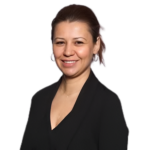



In this episode, Sarah sits down with Seda Arzumanyan, Former Chief Development Officer at Water for Good, to discuss how sustainable water infrastructure and community-led solutions are expanding access to clean water in some of the world’s most fragile regions. Seda shares insights into Water for Good’s work across countries such as the Central African Republic and Ethiopia, where the organization partners with local leaders, governments, and engineers to build long-term water systems that communities can maintain themselves. Together, they explore how empowering local leadership, strengthening water service systems, and fostering collaboration across organizations can help create lasting solutions to global water insecurity.
About Our Guest
Seda Arzumanyan severed as the Chief Development Officer at Water for Good, an international nonprofit organization dedicated to expanding sustainable access to safe water, sanitation, and hygiene (WASH) services in some of the world’s most fragile regions. Water for Good works across multiple countries, including the Central African Republic, Ethiopia, Tanzania, and Cambodia, focusing on long-term water infrastructure solutions that strengthen communities and improve public health outcomes.
In her role, Seda lead fundraising and donor engagement efforts, working closely with global partners and supporters to ensure resources are effectively invested in sustainable water systems. Water for Good’s model emphasizes empowering local leadership and building systems that communities can maintain independently. By working closely with local governments, engineers, and community leaders, the organization focuses on creating durable infrastructure and maintenance systems that ensure reliable water access over the long term.
Through initiatives such as solar-powered water systems, local maintenance enterprises, and partnerships with national and regional governments, Water for Good is helping communities transition from one-time water projects to sustainable service delivery models. These systems not only provide access to clean water but also support economic opportunity, public health, and education particularly for women and girls.
Seda is passionate about collaboration across nonprofits, governments, and local communities to address global water insecurity. Her work focuses on ensuring that investments in water infrastructure create lasting, community-led solutions that strengthen resilience and improve quality of life.
Transcript
Seda Arzumanyan (00:00):
Water is the foundation of everything. We heard the story that a woman in Africa she was pregnant, and she had to walk for miles to get water, and then eventually she lost her baby because it was really hard for her to carry the water jug, which was very heavy. So she actually lost the baby because she didn’t have access to clean water. And then as we improve and create access to water points, it provides support to many women, women who have children, who are pregnant.
Sarah Johnson (00:44):
Welcome to the Pathway podcast. I’m your host, Sarah Johnson, and thank you for joining us for this episode. Pathway to Tomorrow is a nonprofit with initiatives in housing, environmental conservation, and water security. In this podcast series, we engage with leaders working to solve some of the world’s most challenging problems by exploring innovative solutions being implemented by leading NGOs, nonprofits, think tanks, companies, and institutions focused on issues such as homelessness, environmental conservation, climate change, and water security.
Our guest today is Seda Arzumanyan, Chief Development Officer at Water for Good. As Chief Development Officer, Seda leads Water for Good’s development and fundraising efforts. Seda has contributed her expertise to successfully fundraise and develop growth strategies for multiple organizations throughout her career. Previously, she served as a consultant for the European Commission, a development manager and fundraising consultant at Habitat for Humanity Armenia, and co-chief executive officer at Davani.
Seda holds both a bachelor’s and a master’s in social work from Yerevan State University, as well as an MA in philanthropic studies from Indiana University in Indianapolis. Seda, it’s so great to have you on today. Thank you for taking the time to speak with us.
Seda Arzumanyan (02:06):
Thank you, Sarah. Thanks for the invitation. I’m happy to be here.
Sarah Johnson (02:10):
Wonderful. So, Seda, let’s start with your story. What first drew you to the development and humanitarian sector, and how did that path lead you to Water for Good? And also, just for listeners who are unfamiliar with your work, can you give us a quick overview of what the organization does?
Seda Arzumanyan (02:25):
Sure. So I grew up in Armenia, and I did my first degree in social work. And when I started to work at the local nonprofits as a social worker, I actually didn’t work as a social worker. Somehow, my leaders, the supervisors, found a good skill set to do fundraising, and I was engaged in a lot of fundraising activities, organizing galas, working with the donors, and doing grant proposal writing.
And I love doing that. I thought that fundraising is a great channel to raise funds for great causes. And then I decided to move to the United States to do my master’s from one of the best schools, in my opinion, at the Indiana University Lilly Family School of Philanthropy, where I continued to learn about professional fundraising and US giving.
I got a lot of knowledge and a lot of good training from a lot of good professors and practitioners. And then when I graduated, I found a good opportunity at Water for Good. I was really excited about Water for Good because Water for Good is doing really tangible impact in the countries where they need it most.
So water is still a big issue. It’s a global crisis. Still, 703 million people do not have access to clean water, and sanitation and hygiene are the same. They are really big issues globally. So what Water for Good does is provide sustainable, safe water, improved sanitation, and hygiene in places that need it most. So that’s kind of a high overview from my background and the organization.
Sarah Johnson (04:20):
Thank you for sharing that. It’s such important work right now.
So I want to pivot to talk about how you operate in these contexts where you work. Water for Good emphasizes a locally led approach, and you operate in what are considered some of the most complex contexts in the world. For one, the Central African Republic is probably the most complex place you work in, but you also work in Uganda, Tanzania, Ethiopia, and Cambodia.
How does Water for Good tailor its approach to work effectively in fragile and remote regions like this that are subject to lots of conflicts? And what are some of the biggest hurdles your team faces, and how do you navigate them?
Seda Arzumanyan (05:03):
This is a very good question. I think it’s very important to note that even when we go to these countries, as you mentioned, the Central African Republic is the second poorest country in the world. But even if we go to Ethiopia, Tanzania, or Cambodia, we work in the regions where no other nonprofits basically work.
So that’s our mission, and we would like to make sure that we reach out to the places and the people where no one is there or maybe a limited number of nonprofits or help is there. And we have seen a lot of challenges in these countries. We have seen violence and security in the Central African Republic, where we shut down sometimes our operations, but we kept our staff members, and we waited that the peace will come.
So we are seeing a lot of problems with the roads. Some of the communities we need to reach, the roads are not paved. And especially in the rainy season, it’s hard to drive, especially taking the drill rigs to the places to install water points.
We have seen a lot of challenges when there is an election in the country, for example. Sometimes they shut down the internet, or there is violence during those times. So each country has its own challenges, but those are the main things we are seeing: political elections, where it can combine with some conflicts, violence, and roads. The government sometimes doesn’t have a lot of resources to support.
And also hiring people with the expertise to do the jobs. We sometimes hire people and also provide some training.
Sarah Johnson (07:03):
That’s wonderful. I’m sure that’s very important. And do you follow up and maintain contact with these communities after the projects are installed?
Seda Arzumanyan (07:14):
Yeah, first of all, I would like to say that Water for Good is not providing one-time projects. We don’t want to do one water point and then leave the community. What we do is community transformation.
We start with training, engaging the local communities, and community leaders. We start with training about why clean water, sanitation, and hygiene are good things and how this is actually related to their health.
Then we go home to home and engage about 12 hours of training with each family, with each household, engaging the local leaders. We train the local leaders, and then the local leaders go home by home to each community and help them to transform their homes and communities.
We train very basic things. For example, every home should have a basic latrine. And if they don’t have one, we help them to build it. We train them to build their own latrines.
They need to have a handwashing station with soap. Again, a very basic practice that we train them to have at their home. Or if they bring safe water to the home, then where they are going to store the safe water, because it’s very important that you have a safe storage space to store your water.
There are other criteria for how we define what it means to be a healthy home. We help the households and community members go through this training and actually change their homes and become healthy homes.
In the meantime, we create access to water points for the community, for schools, for health clinics, and provide these trainings for churches, schools, and health clinics. So at the end, the whole community gets trained, they change their behavior, which is a hard thing to do, but we have seen that our model has been really successful.
Then we provide water, and we see that at the end we transform the communities. We have seen great results. We have seen a 90% reduction of diarrhea among children under five years old. And you know that diarrhea has been one of the leading causes of children’s death. And now we are supporting them so that the kids shouldn’t die. This is a solvable problem, and we can solve this problem.
So you just need clean water, improved sanitation, and hygiene, and then these results bring a reduction of diarrhea. And we have seen actually that when we complete the project, and we go back to these communities two years after completing the project, we have seen that the reduction of diarrhea has increased 200%. It’s basically decreased, and it’s gone. Diarrhea has gone because of the sustained changes.
Sarah Johnson (10:26):
That’s just an incredible setup. For our listeners, could you just share what the typical or average cost of a project like that is?
Seda Arzumanyan (10:34):
If we do all the aspects, water, sanitation, and hygiene, the average cost is $60 per year, and our project takes three years to do this whole community transformation. So it basically will be $180 per person for a three-year project. But then after that, it’s only maintenance.
We have a sustainability project to make sure that water points and all the other infrastructure are still running. And that sustainability maintenance cost is actually reduced to $2 per person. That’s a key part. You need a little bit more investment when you do a lot of training and infrastructure, but then the maintenance goes down to $2 per person annually.
Sarah Johnson (11:26):
And that’s just so incredible to me. I ask that because $180 per year to prevent something so tragic as a child dying from diarrhea. The statistic, I believe you mentioned, is that 1,000 children under five die every day from diarrhea diseases on the continent.
So, for such a site, I just wanted to highlight what little money is needed to make such a huge lifetime change in bringing clean water to these communities.
So I want to dive a little bit more into how your strategy has evolved over time. Because I know you guys have been around for a long time. You’ve been around for almost 50 years. So I’m sure you’ve seen a lot of changes during that time as an organization.
How has Water for Good’s strategy evolved over time, particularly focusing on your time there? I know you’ve been there for a while. But also, are there particular innovations or technologies that have significantly changed the way you approach your work?
Seda Arzumanyan (12:21):
Yeah, so there’s one major thing that happened with Water for Good in 2024. Water for Good merged with another nonprofit organization called Lifewater, and both organizations were nonprofits working in Africa, and Lifewater also worked in Cambodia as well.
But we did similar work, so our missions were very similar. We wanted to make sure that people have access to clean water, clean, sustainable water. And then we decided, okay, let’s merge and combine resources together, the talent, resources, and improve our efficiency. And we don’t need to compete for resources, and we can be more effective in our work as we do.
So it’s a very rare case, I would say, in the nonprofit sector. You can hear that a lot of corporations are merging, but it’s a very rare thing in nonprofits, and we are really proud of doing this and showing that it actually benefits. As you combine your resources, you can actually reduce the cost.
And we have already produced a report which shows that we are going to reduce about $3 million moving forward because we merged, and now we are going to be more effective moving forward.
Sarah Johnson (13:53):
That’s incredible.
Seda Arzumanyan (13:55):
Yeah, and then in terms of other things we have done. It’s one of the issues in the water sector, especially in Africa, in rural parts of Africa, that we have seen a lot of water points built, but then there was no good maintenance system in place in those locations, in those communities.
Water for Good considers this is not the right thing to do. So whenever you install a water point, you need to make sure that there is a plan and you continue to maintain those water points. And that’s how we established professionalized water services in the Central African Republic, where we maintain over 2,200 water points.
And we have created service provider groups in Ethiopia where they maintain more than 700 water points. And we also support Tanzania to advance their professionalized maintenance services.
So the goal is how we can scale these good models. We have these professionalized maintenance services, and we have seen good results in terms of the reduction of diarrhea cases.
How can we actually take these good examples and help other nonprofits support other communities, either in the countries we work or in other countries as well.
That’s kind of the next step as an organization. We are thinking about how we can provide technical assistance to other nonprofits, maybe to install a water point or think about how they can build a sustainability model, or what’s the best model to engage the communities or train the households about sanitation and hygiene, and change their behavior.
Sarah Johnson (16:07):
Thank you for sharing that, Sarah. So you touched on a lot there. And that’s really interesting, the merger you mentioned with LifeWater. It’s something that we don’t really see in the nonprofit sector. Could you briefly share what the impetus for that was?
I know there’s been a lot of change that the sector has experienced in recent years with regard to funding constraints. If you could just touch on what led you there.
Seda Arzumanyan (16:31):
Neither organization actually needed to merge in terms of finances. When people hear they have merged, then there may be a financial problem. Neither of the organizations had any financial problems.
We worked in different countries. Water for Good was more focused on water access and maintenance. LifeWater was focused more on water, sanitation, and hygiene aspects and community transformation. It was a really good fit to join the efforts because we did a very similar job.
As we merged, Water for Good brought their expertise in terms of professionalized maintenance services. LifeWater has done that as well, and they have good progress there. LifeWater also brought their sanitation and hygiene expertise that Water for Good needed.
So in terms of programmatic work, it was really good. And in terms of talent and staff as well, Water for Good and LifeWater worked on creating more technology sites, good technologies, bringing them and making sure that there is a more global organization empowering the local countries and local teams.
Water for Good was well known in the WASH sector and was working with a lot of grant partners. So I think it was a really good match, bringing a lot of talents and resources together and serving more people.
That was the appetite, basically serving more people, combining resources, and making our work more effective.
And for the donors, I’m doing the fundraising work. I work with the donors on a daily basis, making sure that we are good stewards of our donors’ money and investment.
Sarah Johnson (18:30):
Thank you for sharing that. That makes a lot of sense, actually. One theme I’m seeing emerge as I speak with nonprofit leaders and NGO leaders across many sectors is the crucial importance of collaboration and collaborative efforts to help us achieve some of the goals we have around solving these problems.
So I think that that’s a really interesting way that you guys are leading in that space and hopefully something that others can follow, because it certainly helps to be able to combine resources in that way, I imagine.
So I want to now switch to talk about challenges. This is a really challenging field to be in. In addition to the complexity of the environments that you work in and the conflicts that these countries are typically engaged in, there’s a lot of complexity to the problem you’re trying to solve.
How do you keep the momentum going for such a complex challenge, especially in light of circumstances, whether it’s geopolitical or related to the fundraising environment and resources? How do you inspire your donors to stay committed to this cause?
Seda Arzumanyan (19:42):
I think I can start from the first part of your question. Water for Good is committed to being a global organization. That’s what we announced.
And what does it mean to be a global organization? It doesn’t mean that we work in different countries outside of the US, but it is basically empowering our local leaders and country directors. We also have a headquarters office in Ethiopia, Addis Ababa.
And we empower our local leaders to be in the driver’s seat in terms of strategy development, execution, and being part of donor conversations instead of the US team being the lead. So we are more supportive of the change.
So I think that’s a very distinctive change and value proposition, I would say, as Water for Good, that we empower the local leaders.
I have met our country directors. They are all wonderful and educated people, and they bring a lot of insights. They are able to execute their programs and their budgets. And we train and move in that direction. That’s also my personal opinion. That’s the way you can empower countries and people so that all the projects can be sustainable at the end, rather than going and doing something and leaving as US employees or global employees, and then going back to your country.
So I think real change can happen when you train and empower local people. That’s one thing.
That’s how we navigate all the challenges. Our teams are aware of what’s going on in their countries. They have developed policies and processes on how they can navigate those challenges, and we have done this in the past.
The second part of your question is how we excite people, how we excite our donors to give.
One of the reasons that we are a global organization is that we would like to support the locals, and a lot of our donors like that part. We don’t go and drill wells ourselves. We don’t have engineers in the US that design water points or water systems for African countries. We have really excellent engineers in the countries, in Ethiopia who actually build all these systems.
So I think that’s one part.
And also, it’s a really important cause. Water is the foundation of everything.
We heard the story that a woman in Africa was pregnant and had to walk for miles to get water. Eventually, she lost her baby because it was really hard for her to carry the water jug, which was very heavy.
So she lost the baby because she didn’t have access to clean water.
And then, as we improve and create access to water points, it provides support to many women, women who have children, who are pregnant, and who would like to be active in the job market.
So water is basically the basis. If you create water access in the community, then you change the community life, especially for women and girls.
Then they can focus on education, be active in the job market, and start their own businesses.
We have seen that as we create access to water. We have seen many women entrepreneurs when they started their restaurants, local stores, or other businesses.
So sharing those great stories about how we change people’s lives is important. And when you change people’s lives, it changes their communities and helps with development.
I think that’s where our donors get excited.
And also making the change sustainable for the countries. As I mentioned, empowering local people and creating systems where locals can maintain water points, so it’s not one time One-time support, you go and install a water point, but you actually provide sustainable water services to the communities. So I think that’s where our donors and supporters get excited.
Sarah Johnson (24:03):
Absolutely, thank you for sharing that. That’s such a devastating story again. As you said, water is the foundation of everything.
And to have something like that happen because, like you said, they are walking sometimes several miles, sometimes several times a day, because they can only carry so much on their backs.
So the impact that’s made from a project like this is so massive in terms of the ripple effect it has, on empowering these women to free up their time to start businesses, and for the girls to go back to school. It’s just such highly impactful work that touches on so many of our shared sustainable development goals.
So thank you so much for the work you are doing, particularly in those very challenging areas where some organizations are just not working, as you said.
So now, Seda, I want to ask a little more about some of the alliances that you are involved in. I know that Water for Good is part of the One for All alliance that works with local, regional, and national governments to implement climate-resilient system-strengthening strategies to meet UNSDG 6, which is clean water and sanitation for all.
Can you tell us more about what these system-strengthening strategies are? We hear a lot about systems change, change the system, strengthen the system.
I would love to learn more about what Water for Good’s perspective on that is, and also how this collaboration helps amplify the impact of all organizations involved.
Seda Arzumanyan (26:05):
I actually am coming back from the UNC Water and Health Conference, where I met African government officials and some of the country directors from African countries doing water projects.
And I heard a lot of comments that nonprofits should have a dialogue with the government. You cannot go to the country, do your own projects, and leave. You need to work with the government to create change.
And that’s really good that we hear that requirement or challenge from African countries and governments. That’s a good sign.
So I would say that what we try to do is engage the government, making sure that the government is aware of what we are doing and that what we are doing is supporting their strategies and priorities.
We are not working in isolation from the government and other nonprofits. So it’s very important to collaborate with other nonprofits in the community for the same purpose and see who is doing what.
That’s why, currently, we are thinking, for example, in Ethiopia, to help with district planning. We can go to the district, work with the local government, and help them plan what is needed for their district because they are responsible for providing water to the communities.
That’s their job. So what is their plan? What is the district plan? What is the need? What should be happening there?
And how Water for Good and maybe other nonprofits can contribute and cover some of the needs from that plan.
So now we want to do this in Ethiopia, in one of the regions, and see if we can help the government create a district water plan. And then put the government in the driver’s seat and help them mobilize resources and accomplish their water, sanitation, and hygiene district plan model.
So that’s one of the things, making sure that the government is engaged. And not only engaged in the development, but also making sure that there is a budget line for water.
That’s one thing as well. Most governments don’t have a budget line to support water, sanitation, and hygiene projects for their communities. There are known reasons for that. They don’t have the capacity. But the question is when and how we can get to the point where the government can also have financial investment for local community water and sanitation projects.
Seda Arzumanyan (28:58):
And some of the things, like in the Central African Republic, we are building a system in terms of creating water maintenance services.
The country doesn’t have water delivery services. You can imagine living in the US, we get water, and there is a company, there are technicians making sure that we get this water. If there is a pump issue or any issue, they fix it. And we make our payment on a monthly basis for our water service.
In the Central African Republic, there was no institute like that, there was no agency. Water for Good is actually running that water delivery service agency in the Central African Republic, where we provide services to more than 2,200 water points.
We hire local technicians and train them. Each technician visits each water point twice per year, and they have iPads. They fill out the information as they visit.
If the pump is broken, they fix it if they can because they also take some supplies with them when they visit. If there is a serious issue and they can’t fix it during the visit, then they make a note and go back. And all of this is done using iPads, and it goes to our system.
We look at the situation, how many times each water point has been visited, and other information. And then we ask people to make a payment. That’s also part of it.
Of course, they don’t cover 100% of the operation costs right now, but we have seen good results in terms of solar systems in comparison with hand pumps.
Basically, we are trying to get payments from the communities, which will cover some portion of the operation and maintenance costs. Then we get funding from our donors and other performance-based funding that fills the gap where people don’t cover all the costs.
So it’s a system strengthening because you create a system and then hopefully it can become a financially reliable service that maybe a company can turn into a private company that provides those maintenance services.
Sarah Johnson (31:49):
That’s interesting, a lot of interesting insights there, Seda.
So you touched on quite a few things. One thing that stood out for me is that you mentioned solar systems have had better results than hand pumps.
Can you elaborate on how solar systems are being utilized within this water infrastructure?
Seda Arzumanyan (32:03):
To be clear, we use different types of water infrastructure. It could be hand pumps, solar tank systems, or gravity-led systems.
So different systems are used, and our engineers are really good at doing research and defining what is the best solution for the community is, based on community density, the water source, and different factors. Sometimes a hand pump can be the best solution for the community in comparison with a solar system.
For solar systems, I mentioned that we have seen better payments from the community because it has better benefits for them. It’s easy; you don’t need to pump to get water from the solar tank system. It’s convenient for people, and they don’t have to work too hard to get water.
And the way we have the system in the Central African Republic is that we created a business model. We contract local people to maintain each water point that is part of the solar tank system. They are basically local business people. They manage the water point and collect payment from users when they come to get water. So they pay the tap operator, the water point operator. And then based on these payments, some portion goes to Water for Good, some portion goes to the government, and some portion goes to the local businessperson who does the job.
So we have more than 200 water point operators, and they are local businesses. And that’s how we also develop local business and entrepreneurship in the community.
Seda Arzumanyan (34:17):
And that’s a part of system strengthening, how this can become sustainable.
And now we are in conversation with the government about how this can become an adaptive model for the country. Now we are working in one part of the country, but how this can become an adaptive model for the government.
Similar things are happening in other countries.In Ethiopia, we have already created service provider groups that are already enterprises, they are already business entities. The technicians go and maintain water points, and people are paying the service provider groups, who are already local enterprises.
Based on our rough calculation, during the next three or four years, we are expecting those to become financially sustainable through community payments.
Sarah Johnson (35:16):
That’s wonderful. You’re going in and making an investment in empowering these communities so that they can self-sustain rather than depending on an external organization, which is wonderful.
You can’t really solve this problem without something like that in place. So thank you for that.
So my final question for you, Seda, what new innovations, whether in technology, financing, or partnerships, are you most excited about when it comes to water infrastructure in fragile states?
You’ve already touched on a couple of things here.
And then, as a follow-up to that, I would love to hear about creatively financed projects, insights that you can provide on that, especially given the difficulty of the current fundraising environment with the dismantling of USAID.
We know a lot of organizations have been impacted by a lack of available funds internationally that they were accustomed to receiving.
So what insights could you share on those two fronts?
Seda Arzumanyan (36:17):
I think I’m excited, as I mentioned, that we have great engineers who look at different innovative ways in terms of water infrastructure.
I have been in the Central African Republic and Ethiopia visiting our projects. It was fascinating when I was in the Central African Republic. It’s the second poorest country in the world, and when you drive through communities, you see the poverty.
But then you go to a community and see a solar water tank system that serves multiple water points in the community. You see community members gathered at the water point interacting and collecting water. You see kids laughing and playing next to it. Those solar water tanks have been built by Water for Good.
It was fascinating to see that and see how your work is bringing joy, developing communities, and impacting community life. That’s one thing I’m really proud of.
In terms of systems we are using, we use many systems. We work in five countries outside the US, and we also have employees in France and the US. So we interact across multiple countries.
It’s fascinating how we interact with each other. We use Asana as a project management tool and work daily in that system. All our projects are in Asana. A country director from Tanzania can see what’s happening in Ethiopia and vice versa. It’s very transparent.
Everyone knows what everyone else is doing, and I can send a message to my colleague in Ethiopia or Cambodia. So it’s very transparent how we use different tools like Microsoft and Asana to stay connected while operating as a remote organization.
In terms of fundraising, it has been a difficult time for known reasons. Our approach is to keep our donors engaged, deepen our connections with them, let them know what’s happening, and invite them to be part of the solution and the impact. We are also thinking about empowering local fundraising opportunities.
There are many in-kind opportunities. If there is no cash opportunity, maybe local companies in Ethiopia can provide supplies for water points or sanitation and hygiene projects.
As we are working on our next three-year strategy, that is part of the plan. We are empowering our local teams to think about fundraising and look for local fundraising opportunities.
And also collaboration. You mentioned One for All, and Water for Good is proud to be part of that alliance. We believe we cannot solve this problem alone. We need to collaborate. That’s what we do in the countries where we work.
In Ethiopia, IRC is working and we collaborate with them closely. In Tanzania, Water for Good, Water for People, and IRC are working together and exploring how we can coordinate our efforts and increase our impact. It’s a recognition that one organization cannot change everything. We need to collaborate and make the change sustainable.
Seda Arzumanyan (40:51):
Work with the government and make sure that the change is sustainable for the communities.
Sarah Johnson (40:57):
Absolutely. Thank you for sharing that, Seda.
I love that we’re ending on that note around collaboration because beautiful things happen when we bring our best minds together to think creatively in the face of constraints to solve these problems.
The fact that you’re looking at fundraising from a local perspective and empowering communities to find funding within their own ecosystems is really compelling and an interesting model.
So thank you again for joining us, Seda. It’s been wonderful to learn more about Water for Good and hear these insights.
I’m really inspired by the promise that collaboration, collective action, and innovation hold for forging a path toward a water-secure future for everyone.
And to our listeners, thank you for tuning in. Don’t forget to subscribe to the Pathway Podcast to get alerts on new episodes featuring thought leaders working in housing, environmental conservation, climate change, and water security.
Seda Arzumanyan (42:04):
Thank you, Sarah. Thank you very much for your time.
Sarah Johnson (42:06):
Thank you very much for joining us.