
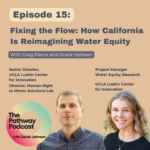




In this episode, Greg Pierce, Director of UCLA’s Human Right to Water Solutions Lab, and Grace Harrison, Project Manager at the Luskin Center for Innovation, join Sarah Johnson to explore how California is advancing water equity through policy, innovation, and community advocacy. From small rural systems in the Central Valley to climate-driven challenges in cities, they discuss the urgent need for investment, infrastructure resilience, and the power of collective action to secure water for all.
About Our Guests
Greg Pierce and Grace Harrison join us from the UCLA Luskin Center for Innovation, where they are advancing research and policy to ensure equitable access to clean and affordable water.
Greg Pierce is the Senior Director of the Luskin Center and Director of the Human Right to Water Solutions Lab at UCLA. His work focuses on water insecurity, infrastructure planning, and environmental service inequities, shaping policy through partnerships with organizations such as the California State Water Board and the World Bank.
Grace Harrison is a Project Manager at the Luskin Center, leading national research on water equity. With a background in environmental health and public policy from UC Berkeley, her work bridges public health, environmental science, and sustainable water management.
Transcript
Greg(0:00): The biggest and broadest challenge is around climate change exacerbating patterns that we already had around drought across the state. Again, it looks different across the state, but it’s basically accelerating drought and making droughts worse when they happen.
Sarah(0:22): Welcome to the Pathway Podcast. I’m your host, Sarah Johnson, and thank you for joining us for this episode. Pathway to Tomorrow is a nonprofit advancing solutions in housing, environmental conservation, and water security.
In this podcast series, we engage with leaders working on solving some of the world’s most challenging problems by exploring innovative solutions being implemented by leading NGOs, nonprofits, think tanks, companies, and institutions focused on issues like homelessness, environmental conservation, climate change, and water security.
Today’s topic: water equity and the future of access, infrastructure, and resilience.
Sarah (1:00): Our guests today are Greg Pierce and Grace Harrison from the UCLA Luskin Center for Innovation.
Greg Pierce is a senior director at the Luskin Center and the director of the Human Right to Water Solutions Lab at UCLA, as well as a professor in the Department of Urban Planning. His research focuses on water insecurity, infrastructure planning, and environmental service inequities. Greg has authored over 50 peer-reviewed articles and works closely with agencies like the California State Water Board and the World Bank to shape policy and solutions. He holds both a Ph.D. and a master’s degree in Urban Planning from UCLA.
Grace Harrison is a project manager at the Luskin Center, where she leads research on water equity across the United States. Her work connects public health, environmental science, and policy. Grace earned her Master of Public Health in Environmental Health from UC Berkeley, where she focused on water affordability for small systems and domestic wells.
Sarah (1:59): Greg, Grace, thank you both for being here today.
Greg(2:02) : Thanks for having us.
Grace (2:04): Happy to be here.
Sarah (2:07): To begin, Greg and Grace, could you share with us what the biggest barriers to achieving water equity and sanitation access are here in California, and can you speak to specific policies that you’ve found most effective in advancing the human right to water?
Grace(2:21) :I can start us off. I think if we’re going to talk about water policy in California in the last ten to fifteen years, it makes the most sense to start with AB 685, Assembly Bill 685, which was passed in 2012. The purpose of this bill was to establish the human right to water in California, making California the first state to do so in the United States. This was a really important bill. It says that everyone should have access to safe, clean, affordable, and accessible water for personal and domestic use. This has been a really catalyzing bill in the last decade, but there are still persistent barriers that exist despite the passage of this bill. That’s what we’re working on, continuing to ensure that everyone in California has achieved the human right to water.
I can talk about a couple of specific issues as examples of some of these persistent barriers. One of the most frequent things that we work on is with small water systems in California’s Central Valley. In addition to domestic well users, these are folks who use wells on their property as their primary drinking water source; they are responsible for their own water. These folks often face chronic drinking water contamination in the Central Valley from contaminants such as nitrate and arsenic. Both of these contaminants are related to agriculture in different ways. Nitrate is usually present because of septic systems or confined animal feeding operations, which are usually called CAFOs, and then, of course, fertilizer use from agriculture. Arsenic is naturally occurring in groundwater, but can become more persistent or more present due to over-pumping of groundwater, which again is related to agriculture.
So a lot of work is being done in the Central Valley to address these, but with the systems being quite small, and with individuals on domestic wells, it can be really challenging to address these types of issues because of limited staff or funding, despite best efforts. There’s been a lot of work going on to improve this. I’d say the most impactful bill that was passed most recently was in 2019, when California established the Safe and Affordable Funding for Equity and Resilience Fund, or commonly called the SAFER program. This is a dedicated fund to assist water systems struggling with problems like this, to establish long-term, sustainable solutions to their challenges, so that in the future, these systems will hopefully require less assistance and can establish long-term success. So those are two important bills passed in the last ten to fifteen years, and I’ll let Greg add on to that.
Greg(5:53): Yeah, I’ll just add a little bit because Grace covered a lot. Again, the human right to water in California, in most places, really covers water quality, water affordability, and accessibility. Grace talked a lot about water quality and the leading efforts that the state of California is undertaking compared to anywhere else in the U.S. I want to talk a little bit about affordability, accessibility, and then mention sanitation.
The bottom line on affordability is that we’ve done a lot in California to recognize this issue and to measure it, but nothing consequential has happened in terms of actually ensuring or supporting affordability across the state. There have been several efforts to pass a statewide low-income assistance program to help people pay their water bills, but they’ve failed. The governor has vetoed them. So, in turn, we have a very patchwork and fairly anemic set of supports run by individual water systems, of which there are many. Water systems are fragmented across the U.S., and we have an ironic situation in which privately owned large utilities offer better customer assistance than publicly owned ones because of legal restrictions.
There are just a lot of issues there, especially as the price of water is going to increase over the next two to three decades in California. Accessibility is probably the least well-defined and hardest to address. The goal here is to ensure reliable minimum access for basic human needs. We’re seeing more places, especially private wells and small to medium-sized systems, either run out of water or get close to running out of water. The state, particularly the Department of Water Resources, is trying to address this and work with counties, but there’s nothing statewide that ensures people don’t run out of water, and that’s going to be more of a challenge whenever our next drought comes.
Then I also want to mention that the state is beginning to look at the sanitation portion of the human right to water. If you look at the language, that’s what the California Human Right to Water law says. Grace and I, and with a large team, are working with the state to try to flesh out where the greatest sanitation inequities and lack of access are across the state. That effort is still in its infancy, and we’ll have to see where it goes in terms of programs or policies.
Sarah(8:31): Thank you for sharing that, Greg and Grace, and for the work you’re doing. It’s certainly a huge concern with the number of “Day Zero” events we’re hearing about happening around the world, cities running out of water, and seeing their taps run dry. Can you tell us a bit about how infrastructure and housing policies, especially at the local level, can be restructured to more effectively tackle water access issues in urban areas, and also, you know, these other areas that you mentioned in the Central Valley and rural areas, but especially in underserved communities?
Greg(9:07): Yeah, I can start us off. I think I’d highlight how important housing and housing type, and whether you own where you live, end up mattering for the human right to water. There are a variety of ways that I can’t even get into here, but the biggest way is still around lack of access in small systems that are managed by private housing communities like mobile home parks, farmworker housing, and other unconventional (though ubiquitous) housing types, where people receive poor service from very small systems that have no economies of scale. Sometimes you have an absentee landlord or manager, and you see real “doughnut holes” even in urban areas, where you’d think it’s a large system serving the whole area, but it’s not. You just have profound inequities there; really, those systems need to be consolidated or integrated into larger systems.
But then there are other issues that are introduced by housing that are less well understood, including something we’ve worked on a lot, which is around urban water quality and the role that ‘premise plumbing” plays in influencing water quality. Basically, a water system is only responsible for ensuring water quality to the point where it reaches private property. With the pipes and the other infrastructure within, wherever you live, or schools or workplaces, is all the responsibility of whoever owns that property. And we especially see in urban disadvantaged communities with high percentages of renters. Basically, people have, you know, discolored or water that tastes bad, smells bad coming out of their tap. A lot of that responsibility, or in most cases, really goes back to landlord sort of negligence, and not fixing pipes or even, sometimes it’s quite simple fixes like changing the end use tap or a filter, an aerator, etc. The solutions involve a variety of carrot-and-stick approaches with landlords and continued advocacy for communities facing foul tap water in their homes.
The final thing I want to mention, really briefly, is, of course, unhoused folks. There’s no clear mandate for who is supposed to provide both water and sanitation for the unhoused. So what you end up seeing with growing unhoused populations, in the state, or at least they have grown recently, is a patchwork of really local efforts. A lot of local non-profits, community-based organizations, were working with local governments in some cases, or in some cases, trying to work around them to provide basic services. But we don’t have, you know, a full systematic approach or even a mandate at the state level for how to address this issue, and it remains a big problem.
Sarah(12:26): Thank you for sharing that, Greg. You spoke to this a bit just now, but in California, there are ongoing efforts to replace outdated piping, particularly in lower-income communities. How do aging pipes, like what you just mentioned, affect drinking water quality, and what can be done to address this?
Grace(12:45): Yeah, this is an important question because, as you said, as pipes age, they corrode over time, and contaminants like lead, copper, or other metals can leach into the drinking water, which can be quite serious over time. California, in particular, banned the use of lead pipes in 1986 because of the serious health effects of lead. Even with this ban, there are still older homes and water systems that have lead service lines. California does have a pretty low number of lead service lines for how large a state it is, but it’s still a big effort to address these, nonetheless.
In 2024, the federal Lead and Copper Rule, which regulates lead and copper, was updated. Now, states are required to inventory and replace their lead service lines within the next decade or so. There’s a big effort moving forward to replace these lead pipelines. As we’ve talked about for small systems, these types of large infrastructure changes can be very costly. They have small ratepayer bases, and this can be a big struggle to afford. There are some additional funds coming through the federal government to accomplish these lead service line replacements, but this can be slow; it can be slow to receive the money.
Even if a system doesn’t have lead pipes in particular, they have pipes and pipes age and will require replacement over time because of corrosion of other contaminants like copper and metals. Or just generally, you know, infrastructure ages, it breaks down, it needs to be replaced, pipes can begin to leak. If these replacements weren’t in a system’s long-term financial plan, it could be quite difficult to afford. So, lots of work is actively being done on this because it is a priority of the federal government, and this will take at least the next ten years, if not longer, to address.
Sarah(15:08): Thank you for sharing that, Grace. It sounds like a large undertaking, on a challenge that needs to be addressed. I’d like to pivot to talk about climate change. As we know, climate change is creating new challenges every year — droughts, wildfires, and more. How are these factors shaping water challenges in California today, and what strategies or policies are most effective for building resilience?
Greg(15:35): Yeah. So it’s again a massive topic to talk about how climate change is shaping water challenges in California. I’m going to kick us off and start with the biggest and broadest challenge is around climate change exacerbating patterns that we already had around drought across the state. Again, it looks different across the state, but it’s basically accelerating drought, making droughts worse when they happen. I will note that heat and rising temperature are contributing to that as well, and contributing to what people are calling sort of the ratification of the natural environment, so it’s quite problematic.
But, again, there are so many ongoing efforts. It does look pretty different between large urban systems and small rural ones. The larger urban systems are driving a lot of innovation and basically focus on new water sources, and especially local water sources that some people call “drought-proof”. Although none of them is entirely drought-proof. So we’re seeing a lot of innovation there, but it’s expensive. Whereas in smaller systems, there just frankly aren’t a lot of options for new sources. A lot of small systems, almost all small systems that rely on one source, usually a groundwater source. So again, the options there are either about better stewardship of that. I think Grace will talk a little bit about what that looks like at the state level, but also about consolidation and finding ways to integrate with other systems.
The second thing I want to mention is wildfire, which we’ve been working on very conservatively, especially since the January 2025 fires in Los Angeles. Again, I can’t go into all the challenges that water systems face related to wildfire, but wildfires are becoming more frequent and, most importantly here, more fierce. And when they happen and impinge on urban areas, they’re really affecting water systems, and we’re expecting water systems to help fight wildfires in ways that we literally never would have anticipated a decade ago. So there are all sorts of efforts going on to make water systems more resilient. Again, both to be impacted by wildfires or to be less impacted, but also to fight wildfires. There are a lot of limitations there and a lot of misinformation about what water systems should be doing there, so it’s quite a challenge.
The final thing I want to mention, and just briefly, is that, despite a lot of the focus on sort of aridity, less water, more heat, more fire. We do have issues just due to climate change with the concentration of precipitation events. So we do have more concerns about flooding than we did before. When it rains, it rains harder. And all of our infrastructure is built for sort of averages and old notions of the worst storms that we’re going to face. And we do have some parts of the state, of course, those on the coast, especially in Northern California, that are facing the challenge of sea level rise due to climate change. That’s not the whole state, and we’re not as poorly off as plenty of places on the East Coast, but it is something that we’re facing here as well.
Grace(19:07): I can add on to Greg’s comments about drought and speak a little bit about how the state is working to maintain the groundwater that we currently have and steward those sources. I will start by mentioning that the state of California passed the Sustainable Groundwater Management Act, which is commonly called SGMA, in 2014. This law mandates that local water agencies manage their aquifers sustainably by 2040. Obviously, “sustainably” is sort of a broad term; sustainable management really means protecting groundwater from overpumping during these drought seasons, and maintaining long-term aquifer reliability through actions like groundwater recharge to replenish the aquifer.
There has been success with this program; large numbers of groundwater sustainability plans have been submitted to the Department of Water Resources. These plans are showing how they lay out how the water agency is planning to more sustainably manage the aquifer. The state of California has seen an increase in groundwater supplies since SGMA was put in place, so that’s a positive. However, some regions do continue to struggle to meet SGMA sustainability goals and require additional oversight or assistance from the state to make sure that these aquifers are being sustainably managed. I think I’ll leave it at that.
Sarah(20:54): Thank you, Grace and Greg. There’s a lot to discuss here. It’s great to hear about SGMA, which sounds promising. It really is a perfect storm we’re facing. Climate change is creating so many challenges, particularly around infrastructure. But I’d like to talk about solutions. Looking ahead, what promising solutions are being explored? For instance, we’ve heard a lot recently about recycled water and how it can improve agricultural practices or infrastructure innovations. How can these help meet our state’s growing water needs?
Greg(21:32): Yeah, that’s a great question, and I’ll take a shot at it first. Again, it’s different between urban and rural areas; there’s frankly less to say about rural ones. There’s frankly less to say about rural areas, but in urban areas, like I mentioned before, there are very large efforts to transition and diversify the water sources we rely on due to climate change. By far the biggest efforts that are now ongoing are around centralized recycled water or turning wastewater into drinking water. The technology has been there for a while, and the regulation has caught up with it. Every urban area in the state either has already implemented it, for instance, in Orange County, or is working on implementing it at scale with the ambition to recycle all of the water, all of the wastewater that we have. In places like Los Angeles and San Diego, with the Bay area being a little bit more modest in terms of its goals, but that’s really the biggest bang for your buck by far in terms of “new water”.
Then, there’s been an increase in agricultural efficiency for a while. That really matters because agriculture still uses 80% of the water in the state, compared to 20% for urban or direct human uses. So even small gains in agricultural efficiency lead to large gains in the amount of water that’s available for other things. There are technological innovations, some of which relate to things like artificial intelligence, certainly to information communication technology, the ability to basically know when to water most efficiently.
But it’s not just about technology. A lot of it does come down to markets and incentives as well, with long talked about potential for water markets to have a real impact, finally coming to fruition or being actionable now. Especially around potential trades and water banking in agricultural areas or rural areas, as well as the opportunity for agricultural sales to urban areas. Which, frankly, I don’t think are optimal or exactly equitable, but they’re better than the way we’ve been doing things based on the century-old sort of notion of water rights.
The last thing I’ll throw out, and then I know Grace has some comments too. There are real challenges in the water space around game-changing innovations, and the way that we see energy and transportation. That’s true for a lot of reasons. I think one that maybe I’m getting a little bit more bullish on, although I’ve been skeptical in the past, is around ocean desalination, especially with new technologies that are promising. You have environmental advocates even saying that they endorse technologies that will have minimal or even no environmental impact, and can produce a water supply at scale. Those have not actually been tested at scale. I think the jury is still out, but I think maybe we’re getting there in terms of desalination, turning ocean water into potable water, which will be very important. It doesn’t have limitless potential, but it obviously has a lot of potential because we have a lot of ocean water, a lot of population near the coast.
Grace(25:16): The innovation or solution I wanted to highlight is stormwater capture because, like Greg mentioned, with climate change, rainfall is often becoming more intense and less predictable. So stormwater capture is becoming more important. When we talk about stormwater collection, we’re talking about water that’s coming off of streets, rooftops, or even natural landscapes – a multitude of options there. But the purpose of stormwater collection is to augment the local water supply, or it could be used to recharge aquifers, like I talked about with the sustainable groundwater management. California’s invested, I think, more than $160 million currently to capture and reuse stormwater throughout the state. This is a large initiative, and it’s going to continue to grow, and although California is trying to capture as much stormwater as possible currently. I want to make sure that we commented that some natural runoff is still needed. We can’t capture all of the stormwater, although the state is trying to capture as much as possible; some runoff is needed to support fish and other wildlife in their natural environments. At other times, the water flow is just too intense, and it needs to be released to the ocean, and that’s okay, that’s normal.
One other stormwater policy that I want to mention was implemented in Los Angeles in 2018, which is Measure W. This is a property tax that has generated, I believe, about $300 million a year for stormwater capture projects. So a lot of innovation is happening through Measure W, and yeah, there’s a lot being done on this already in the state. Because of the last couple of years with extreme flooding and a lot of stormwater occurring at one time. So I think it’s going to be an area of growth for the state. Looking forward to seeing what we can work on next there.
Sarah(27:28): Thank you for sharing more on that, Greg and Grace. That sounds really promising, the investment in stormwater capture and Measure W. You know, I think you hear a lot of people say or think this isn’t such a big problem because most of the world is water, right? But as you mentioned, Greg, desalination being a potential solution, I think that we don’t understand, or it’s not commonly understood, how expensive that intervention is. It’s encouraging to hear about what we are working on in California with regard to stormwater capture and other solutions. Can we talk now about some standout examples that you have seen of successful community-driven solutions to water or sanitation security?
Grace(28:15): Sure. There have been a significant number of communities that have been heavily engaged with advocacy work for their community and neighboring communities throughout California. Many of those communities have worked closely with organizations like Community Water Center, RCAC, or Self-Help enterprises, which are sort of advocacy and technical assistance organizations that largely work in the Central Valley of California, but also throughout the state.
There are a lot of different examples I could pull from, but one well-known example It’s been pretty well covered in the state journalistically; maybe you’ve heard about it. East Porterville is in Tulare County, a small community in an agricultural area. This community partnered with community water centers, self-help enterprises, I believe, also our RCAC to advocate for emergency water to be delivered to their community because they experienced nearly a thousand, I think, a thousand domestic wells, private wells. Again, these are wells that an individual or a household is, is using for their drinking water or household water source, and their wells went dry due to drought in the area. This community had also dealt with and continues to deal with arsenic and nitrate in their water, like I spoke about at the beginning, because of agricultural exposure and overpumping of the aquifer. And so, as a solution, this community advocated with these organizations to get bottled water delivered to their community. They had new storage tanks installed so that water could be hauled in and stored for longer use.
Their advocacy led to additional state and federal funding for longer-term solutions, so not just this emergency water, but also longer-term improvements. So in the end, I think about 900 households were able to be consolidated with a larger neighboring municipal drinking water system so that their water source would be more reliable and hopefully well-treated. This has been a success. Obviously, there is a lot of ongoing work in this community and in the neighboring communities. But it’s a very excellent example of advocacy groups coming together with a community and speaking to the state about their needs.
I also just want to mention, because of Greg and I’s work on sanitation access, that East Porterville has also struggled with safe and reliable wastewater, caused by sewage spills and failing septic systems in their community. Similar to the drinking water consolidation, some of these small wastewater systems were able to be consolidated into the neighboring municipal sewer system. That was another solution that this community was able to find. Again, there’s a lot of ongoing work going on in East Porterville and similar communities nearby. This is a success story, and we need to continue being engaged and advocating for their human right to water.
Sarah(31:49): Thank you for sharing that, Grace. It’s encouraging to hear that advocacy can result in these kinds of positive outcomes for communities and for sharing those resources that folks can turn to, such as CWC, RCAC, and SHE. So, for my final question, Grace and Greg, I would like to understand, and I think our listeners would love to understand, what role individuals can play in advancing water equity – whether it’s testing our taps or reducing our personal water footprint. What matters most at the individual level?
Greg(32:26): Yeah, I’ll take a shot at that, and Grace can add, if she has other thoughts. I’d start by saying, I think it’s easy to feel like an individual contribution can’t make a big difference. I think in this case it can, but we’re not pretending that; it’s all about individual action. A lot of it is about collective action and about government action. So I’m just going to throw out a few things that individuals can do that have varying degrees of control over the situation.
The first and broadest would be if you have time, which I realize a lot of folks don’t, to try to really engage with your local water agencies. First of all, find out what they are and engage with local nonprofits or community-based organizations that are already working on water in your community. Usually, those exist again. If you don’t know what those are, you can Google it or contact us, and we can try to give you some ideas. But engaging at a higher level can have a big impact because a lot of folks aren’t very engaged on water. And so even as an individual, if you get involved with an organization, you can have a kind of outside say.
Another thing would be to really learn more about your own tap water quality, and to help stop the spread of misinformation about tap water quality. We haven’t talked about it too much here, but there are a lot of folks who think tap water is unsafe everywhere, or tap water is unsafe where they live, when it’s actually fine and good and safer than bottled water or other types of beverages. A lot of people are sold lies by beverage companies or even door-to-door salesmen selling you filters. And they’re basically throwing a lot of money down the drain. Again, relying on less healthy products and increasing plastic waste, etc. You can also test your water. Some companies help you test your water, and some water systems – the bigger ones- will come out and test your water if you’re concerned about it. But simple labs are a good option if you’re in a domestic well or your system won’t test for it. But you can find out that information directly. And if you’re served by a large system, read what they call the consumer confidence report that should be mailed out to you every year.
Then, other things that you can do; there’s already been a big push in the state, a lot of people are on board with conserving water, meaning using less water, or as I heard just yesterday, not using less water, but wasting less water. There are usually opportunities for everyone to do that if you’re a homeowner. The biggest bang for your buck is conserving outdoors, which’ll make a big difference. You can also save money by doing that, but also conserving indoors all the conventional things, including taking shorter showers, turning off the water when you brush your teeth, which does make a difference.
But then I’d say more broadly, and maybe the most important long-term thing is – it goes back to the first point- is knowing what your local water systems and agencies are, and particularly a lot of them are public. Most of them are public, and you have opportunities to vote on who is on the board of those agencies. A lot of people don’t realize that, or just pass through those things on the ballot when they get it. But voting in those elections matters a lot, and getting educated on that is important as well as voting more generally, you know, for broader candidates. I realize that people are voting on several different issues, and water is only one of them. But just getting informed about what sort of, you know, your city, county, state, and federal officials think about water. And because they influence a lot of the policy, at the end of the day, there are limits on what an individual can do. But using your voice is always a good place to start.
Conclusion
Sarah(36:41): Absolutely. Thank you so much, Greg. I think a lot of us don’t realize just how many gallons of water a long shower can consume, so shortening your shower time can make a significant impact. And to your comment about voting and just being aware that this is an issue that we should be paying attention to, especially with the number of day zero events that are happening in developed countries, in cities where you wouldn’t expect this to be occurring, including here in the United States.
Greg and Grace – thank you so much again, both of you, for sharing your insights and for the critical work that you’re doing at the Luskin Center for Innovation and the Human Right to Water Solutions Lab. It’s encouraging to hear how research, policy, and community action are coming together to create real change in the space of water equity and resilience in California.
And to our listeners, thank you for tuning in. And be sure to subscribe to the Pathway podcast to hear more from thought leaders and innovators working on solving some of today’s most urgent environmental and social problems.