
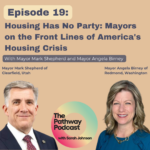




In this episode, Sarah sits down with Mayor Mark Shepherd of Clearfield, Utah, and Mayor Angela Birney of Redmond, Washington, to discuss how local leaders are tackling the national housing crisis from the ground up. Together, they explore their work with the Mayors and CEOs for U.S. Housing Investment Coalition, a first-of-its-kind bipartisan effort bringing together mayors and corporate leaders to drive federal housing policy. Mayor Shepherd shares how Clearfield has entitled, permitted, or built over 4,000 housing units in a city once considered built out, and his passionate advocacy for affordable housing near military installations. Mayor Birney discusses how Redmond has transformed from a car-dependent suburb into a vibrant, transit-oriented city through light rail investment, middle housing expansion, and climate-conscious development strategies. The conversation also examines the critical role of federal tools like Section 8 vouchers and LIHTC, the cost of permitting delays, and what it will take to meet America’s growing housing needs.
About Our Guests
Mayor Mark Shepherd has served as Mayor of Clearfield, Utah since 2013, bringing nearly nine years of prior experience on the Planning Commission and six years on the City Council. Outside of public service, he is the founder and principal broker of Shepherd Real Estate Group, specializing in military relocation. A strong advocate for military communities, Mayor Shepherd serves in multiple leadership roles supporting defense and installation development, including as a civic leader for Air Force Materiel Command. Under his direction, Clearfield has entitled, permitted, or built over 4,000 housing units in the past five years in a city once considered built out. He serves as co-chair of Mayors and CEOs for U.S. Housing Investment and co-chair of America’s Housing Comeback, and was recently appointed to the Board of Directors for Utah’s Private Activity Bonds, responsible for awarding low-income housing tax credits.
Mayor Angela Birney has served as Mayor of Redmond, Washington since 2019 and is currently in her second term. A former middle school science teacher, she brings a community-centered and forward-looking approach to leadership as she guides one of the region’s fastest-growing cities. Under her leadership, Redmond has expanded housing supply through middle housing and accessory dwelling units, updated zoning to support greater density, and advanced transit-oriented development along major light rail investments. Her work emphasizes building a complete, sustainable city where residents can access daily needs within a few blocks, while integrating climate-conscious strategies like electrification and reduced car dependence into long-term planning. Mayor Birney serves on numerous regional, statewide, and national boards focused on housing, transportation, climate, and economic development, and is an active member of the Mayors and CEOs for U.S. Housing Investment Coalition.
Transcript
Mayor Shepherd (00:00):
We’ve got a major problem in the country right now, and it’s gonna take a whole lot of people to solve it, and it’s not just one person’s problem. There wasn’t one entity that caused it. It wasn’t the home builders, it wasn’t the realtors, it wasn’t the cities. But it’ll take every single one of us to bring it together and find a way to solve this problem. And I think there are solutions out there, but it’s gotta come from ideas from every angle.
Mayor Birney (0:12):
I think all of those things come together to make our communities better. It is all of us working together to create more housing. And it’s like the Mayors and CEOs for U.S. Housing Investment; it’s all of us working together to create more housing on the national level, and we are all bringing it into the local level to ensure that our communities have the housing that we need for people to live here.
Sarah Johnson (00:25):
Welcome to the Pathway Podcast. I’m your host, Sarah Johnson, and thank you for joining us for this episode. Pathway to Tomorrow is a nonprofit with initiatives in housing, environmental conservation, and water security. In this podcast series, we speak with leaders who are shaping the future of our cities, people working at the intersections of housing policy, climate, and sustainable development to create solutions that meet the demands of a rapidly changing world.
Sarah Johnson (00:54):
Our guests today are Mayor Mark Shepherd of Clearfield, Utah, and Mayor Angela Birney of Redmond, Washington. Mayor Mark Shepherd is currently serving his thirteenth year as Mayor of Clearfield, Utah, where he was first elected mayor in 2013, after nearly nine years on the Planning Commission and six years on the City Council. Outside of public service, he is the founder and principal broker of Shepherd Real Estate Group, a company specializing in military relocation. A strong advocate for our military communities, he serves in multiple leadership roles supporting defense and installation development. He has served as an honorary commander for the 388th and 419th Fighter Wings and presently serves as a civic leader for Air Force Materiel Command. He’s currently working on legislation with Congressman Blake Moore to add affordable housing for our military members in the communities surrounding an installation.
Under Mayor Shepherd’s direction, Clearfield has entitled, permitted, or built over 4,000 housing units in the past five years in a city that was already considered built out. He serves as the co-chair of Mayors and CEOs for U.S. Housing Investment, as well as the co-chair for America’s Housing Comeback, a partnership between the National League of Cities, the National Association of Realtors, the National Home Builders Association, the American Planners Organization, and several other associations involved in bringing housing to the market. He was recently appointed to serve on the Board of Directors for Utah’s Private Activity Bonds, which is responsible for awarding low-income housing tax credits.
Mayor Angela Birney has served as Mayor of Redmond, Washington, since 2019 and is currently in her second term. A former middle school science teacher, she brings a community-centered and forward-looking approach to leadership as she guides one of the region’s fastest-growing cities. Redmond, home to more than 80,000 residents and nearly 100,000 jobs across industries like aerospace, high-tech, gaming, and biotech, is rapidly evolving from a suburb into a more connected and dynamic urban center. Under her leadership, the city has expanded housing supply through middle housing and accessory dwelling units, updated zoning to support greater density, and advanced transit-oriented development along major infrastructure investments like light rail. Her work emphasizes building a complete, sustainable city, one where residents can access daily needs within a few blocks, while integrating climate-conscious strategies such as electrification and reducing car dependence into long-term planning.
Mayor Birney has also played a key role in advancing innovative housing solutions, including financing tools to support affordability for first-time and low-income home buyers, and advocating for strong federal-local partnerships through efforts like the Mayors and CEOs for U.S. Housing Investment Coalition. In addition to her local leadership, she serves on numerous regional, statewide, and national boards focused on housing, transportation, climate, and economic development, helping to strengthen collaboration and bring resources to her community.
Mayor Shepherd and Mayor Birney, it’s a pleasure to have you both on today. Thank you for joining us.
Mayor Shepherd (03:50):
Well, thank you for having us.
Mayor Birney (03:52):
Yes, thank you.
Sarah Johnson (03:53):
To begin, could each of you share what inspired you to join the Mayors and CEOs for U.S. Housing Investment Coalition, and what personal experiences or challenges in your cities have shaped your housing priorities?
Mayor Shepherd (04:04):
Sure. Mayors and CEOs for U.S. Housing Investment is a bipartisan coalition. It’s really the first of its kind to bring together mayors from across the country, from different sized cities, different demographics, and then to combine that as well with CEOs of corporations looking to improve housing supply. And so the opportunity to be a part of that and to shape housing policy is crucial to me. It falls in exactly with where my term has been, where I’ve sought to have influence throughout my service as mayor. And so it was honestly a perfect fit for where I needed to be. We’ve got a major problem in the country right now, and it’s gonna take a whole lot of people to solve it, and it’s not just one person’s problem. There wasn’t one entity that caused it. It wasn’t the home builders, it wasn’t the realtors, it wasn’t the cities.
But it’ll take every single one of us to bring it together and find a way to solve this problem. And I think there are solutions out there, but it’s got to come from ideas from every angle. And that’s the beauty, I think, of Mayors and CEOs for U.S. Housing Investment — it gives us that opportunity now to go to Congress, talk with our representatives, and bring ideas to them to get into legislation. And we’ve seen that be effective already.
Mayor Birney (05:26):
And I will just add that it’s been an exciting opportunity for me as a mayor of a city in Washington State, but also as a representative of the state of Washington and the other organizations I belong to, to bring the voice of growing cities into the conversation. I like to think that the Mayors and CEOs for Housing Investment really brings together a lot of different perspectives. Not all of our cities are the same, but it is really interesting to see how many of us have the same issues that we bring forward. And so this collaboration really can make a big difference, I think, in every U.S. city in the country and really bring housing onto the market that we all need.
Sarah Johnson (06:12):
Thank you to both of you for sharing that. It’s an exciting coalition, as you said, first of its kind, and we’re hopeful for what can be uncovered in this collaboration. My next question for both of you is: how has being part of a bipartisan coalition like Mayors and CEOs for U.S. Housing Investment strengthened your capacity to address local housing crises? And can you also share a specific example of how federal advocacy has translated into local action?
Mayor Birney (06:40):
Sure, I can go first. Bringing us together creates an opportunity for us to explore the different opportunities that the national conversation can bring to us, be it for LIHTC, for affordable housing, or decreasing the time it takes to go through federal permitting processes. I think things like that all are great opportunities nationally that can be used at the local level. Thinking about what that national legislation can do for a local jurisdiction — one of the things I’m really excited about in the current housing bill that’s moving through Congress is that there’s an innovation fund that can go to cities like mine and others that are really trying to push the envelope on — what is innovative in our cities and how we can get federal support to make those things happen. We have really focused in Redmond on so many different things, but a big push has been around transit-oriented development. And that is an area that is really important for community members to be able to live near transit, to live in more sustainable housing, and to be able to be part of our community in a much easier and cohesive way. So that’s just one of the areas from this current housing bill that I think will be a real boon for local jurisdictions.
Mayor Shepherd (08:01):
I agree with her a hundred percent. When you’ve got a bipartisan coalition — and we just came back from Washington D.C. last week — to be able to take a bipartisan coalition into Congress’s offices, whether that be the House or the Senate — and party doesn’t matter, because housing doesn’t have a party–and to be able to explain to our congressmen and our delegations that this isn’t a Republican or a Democratic issue. And I think that’s the real strength of this — to say, look, we’ve come together. Many of us are partisan and many of us aren’t, but we joined together without party to address a problem. It was exciting to hear that in Congress this last week as we sat down with representatives and to have them talk about my representative from the other side of the isle and say, wow, you’ve got people that are really trying to bring people together, and this is an issue we can address together.
We’ve advocated for a lot of things at the federal level over the last year or so with Mayors and CEOs. And a lot of that is probably more recognition for what we’re trying to do. Again, I mentioned that I’ve been working on housing legislation with Congressman Moore, and you find it’s a long process. You really want to address things quickly. We all started down this road with Congress a year ago and sat in their offices and said, these are the things that we need, these are the things that we want to accomplish. And as we did that, their bill came out. We’ve had first the Road to Housing Bill, then the 21st Century Housing Bill, and now the 21st Century Road to Housing Bill. And almost everything that we went in and asked for ended up in this legislation.
The long-term benefits for that will be fantastic. And I know we’re still a little bit away from getting this done, but I truly believe that in talking to our representatives there, that by July we actually have an approved bill that the president can sign. That will give so much flexibility in the things that we do locally, in how we use CDBG funds, and how we take care of our residents and how we provide housing. It’s fantastic.
Sarah Johnson (10:18):
Thank you to both of you for sharing that. It’s very encouraging to hear that there’s been so much support for this, and just to see everyone coalescing around a common goal is really encouraging. For my next question, I’d like to ask about a particular aspect of the coalition. One core mission of the coalition is promoting public-private partnerships to increase affordable housing production. How have your cities leveraged these partnerships, and what lessons could other cities learn from your approaches?
Mayor Shepherd (10:49):
As you mentioned in our opening, Clearfield has entitled, permitted, and built 4,000 housing units in the last five years. And we were a city that, when I took over, was told we were built out. We had very little land, and so we had to go vertical. But the only way to do that was for the city to start acquiring land and then to start working directly with developers to say, this is how we want these things to work. And we truly created partnerships with those developers — we know what they want, they know what we want. We’ve brought in the local community, we’ve started purchasing lots and partnered with the Realtor and Home Builders Association to create some low-income housing. To me, that’s the answer to all of this — you can’t do it without those partnerships. There’s got to be give and take from both. There’s got to be a commitment from every angle to create the housing. And I think that’s really what we’ve done, and it’s what has allowed us to make that happen.
We have created a commuter rail station in Clearfield that will ultimately, when we’re done, have another thousand units of housing. It is a partnership between the city, the Utah Transit Authority, and two other developers to create a community around this transit station. Again, that doesn’t happen without partnerships. The city went in and created all of the horizontal infrastructure to speed this along. We’ve bonded for that effect to really say, this is our piece, now let’s bring in your piece as well. And it’s a fantastic partnership that will eventually house an enormous amount of people and quite a bit of business around it.
Mayor Birney (12:27):
I just love hearing that, because that’s Utah and I can think of many examples in Washington State and other things throughout the country that I’ve heard from other mayors. In Redmond, we are really fortunate — we have some major corporations that have built up a housing account to help in funding some of the harder-to-fund projects for lower-income properties. But we also work directly with the Master Builders Association and talk about what the challenges are that they have with our permitting process, and we’re working towards streamlining that — getting their perspective to help us do a better job. We just have a lot of ways that we bring in our partners to build more housing, to simplify the process, and to think about what’s next.
We’re working through middle housing in our city. We made that something that could happen in the last couple of years, and now we’re working through the permitting with our partners that are building the homes, and community members, and with that we hope to see quite a bit of middle housing coming online in our community. We’re seeing a lot of permitting on that and a lot of investment in that. And I think all of those things come together to make our communities better. It is all of us working together to create more housing. And it’s like the Mayors and CEOs for U.S. Housing Investment — it’s all of us working together to create more housing on the national level, and we are all bringing it into the local level to ensure that our communities have the housing that we need for people to live here.
Sarah Johnson (14:06):
Thank you, Mayor Shepherd, Mayor Birney. It’s really encouraging to hear about the various initiatives, particularly the strides that you’ve made, Mayor Birney, with middle housing, which is a challenging population to build for. We just had a recent conversation on the podcast about this, so I’m excited to dive into that later on in our conversation. My next question is addressed to Mayor Shepherd specifically. I’d really like to learn a bit more about your work with military communities. Clearfield is a community deeply connected with nearby military installations, and you’ve advocated for expanding affordable housing options specifically for military families. How has this challenge shaped your engagement with Mayors and CEOs for U.S. Housing Investment, and what legislative or policy wins are you most proud of in this area?
Mayor Shepherd (14:50):
Clearfield is a military community. In fact, we actually rebranded ourselves last year as Utah’s Military City. We have Hill Air Force Base and we are the gateway into Hill Air Force Base, which means during the day we bring in an additional twenty-some-odd thousand people into the community. They continue to hire at Hill. We’ve got multiple missions at Hill, and Hill only has, as most installations do, a very limited amount of housing. Most of that is dedicated to brand new airmen coming in who are allowed to stay there until they’re promoted. And then the others are for Chief Master Sergeants and other leadership. And so once they’ve reached a certain point, they don’t have a choice but to move off base.
What we found happening is that their pay had not kept up with the rise in housing prices. Utah has just exploded, as have a lot of other states, but it was one of the most desirable places to live, and people started moving here from everywhere. And so the housing supply was already limited. And then all of a sudden I’ve got airmen that I found were doubling, tripling, quadrupling up in apartments just because they couldn’t afford housing any other way. It was either they double or triple up in an apartment with their friends, or they end up in the food lines. And as a mayor, I can’t sit there next to a military base and see members of our military community sitting in a food line. To me, that was the worst thing I could possibly see. And so we started looking at ways — how do we help the base? How do we create housing that will allow those airmen to live within their means, within their basic allowance for housing that they’re given by the military?
It is a real challenge. Getting legislation through is difficult. And so we’ve really had to try to be innovative. The legislation that I’ve got with Congressman Moore will allow us to build within 15 miles of any installation and allow them to dedicate that housing. Not specifically — they can’t mandate that they can only rent it to military people — but it will give them preference for it. And those rates will always be within the amount of housing allowance that they’re given. That hasn’t been done before.
And it’s a stretch to try to do that, but in that same legislation, we said, look, one of the biggest problems with our military is that even though they qualify for low-income housing, they can’t get into it for two different reasons. One, they don’t stay long enough. And two, if you calculate all of their income, including the allowance they give them for housing, they make too much money. Well, they don’t make too much money, but they have this housing allowance coming in on the side, and so it shows that they do. And so in this bill, it also removes that requirement and takes out the calculation or the basic allowance for housing from the calculation for income, so that they do qualify if that’s the only housing that’s available.
In the end, the idea is to provide enough housing off base that they’ll be able to live. I met with Congress this last week and then with senior staff for the Air Force to look at starting to move on base, and build dormitories there. I met with a mayor in New Mexico who has partnered with a developer and built dormitory-style housing for the airmen off base. And it feels very much like dorms, but everything fits within their budget. And to get to that point is a miracle. Working with the federal government alone is difficult. It’s even more difficult when you try to tie in the Department of War and say, we want to accomplish this, and they just don’t talk. The Department of War and Congress itself are not sitting at the table saying, how do we address housing? Congress is looking at one angle, the military’s looking at another angle. And we’ve got to have those brought together.
And I really think that’s been the answer. Again, our Road to Housing Act — the Senate passed theirs, and hopefully we get this to the finish line. Because I think long term, this frees up housing for everybody. And to me, the military is my passion. It’s getting these guys out of the base that is going to be crucial for us, and getting them a place to live where they can actually feel comfortable. It is, in all honesty, a national defense kind of crisis. Because if you’ve got people that are living on base, in whatever branch of the military you’ve got, if they don’t feel comfortable where they’re living — if they feel like they’ve been put into the slums, or into less than ideal housing because that’s all that’s available to them — they don’t reenlist. They don’t want to sign up because that’s where they’re gonna have to live. And we just can’t do that as a country. I think that will hurt us in the long term. So I think the things that we’ve got going with Mayors and CEOs, that we’ve been able to start getting into there as well as this legislation with Congressman Moore, will make some deep impact on this.
Sarah Johnson (20:30):
Thank you for sharing that, Mayor Shepherd, and for advocating for this very important demographic. I’m sure it’s a challenge in many cities across the country, and so, hopeful that this will help solve that challenge. My next question is for Mayor Birney. Mayor Birney, Redmond has experienced rapid growth alongside major infrastructure investments like light rail expansion. How have you approached aligning housing development with transit-oriented growth, and what opportunities does this create for building more sustainable, connected communities?
Mayor Birney (21:05):
Thanks so much for that question. I’m really proud of the work that Redmond has done around the light rail investments in our community. To kind of set the stage, when I moved to Redmond 28 years ago, there wasn’t really much of a downtown. There were businesses and there was a little bit there, but there wasn’t really a lot to call downtown. And then over the years, there’s been very big investment in light rail. The city of Redmond now has four light rail stations, and our light rail just recently opened up from downtown Redmond, and now you can go across the floating bridge into Seattle and beyond in the region. So that’s brought an amazing opportunity for us.
And fortunately, in thinking about what we should do in Redmond with these stations, we didn’t think small, we thought big. We thought, let’s make those stations the centerpoint for what can happen for a community if we invest in planning that creates housing around these light rail stations — dense housing that creates other transportation opportunities, that creates walkable, bikeable communities with other amenities around there, so that someone can live near a light rail station and get to their job or other things they want to do very easily. But, they can also walk out their door down the street to a grocery store. They can get on a trail and bike or walk all over our region. They can walk nearby and get to daycare or other things that they need in their regular everyday lives. And creating those kinds of spaces in our community has been an amazing thing to see come up out of the ground over the years.
So that now when you come to Redmond — when you come to the downtown station in Redmond — you see a downtown. You see vibrancy. People are out and about, going about their daily lives. They can walk down to the park and enjoy a big festival on some weekends, they can walk to a different park and have a playground for their kids. But it’s just really created this amazing vibrancy with that investment in transportation, and has created so much more for our community, and has really created this very special city that I just see continuing as we continue to invest in those spaces.
Sarah Johnson (23:36):
Thank you for sharing that, Mayor Birney. If I may ask — prior to this investment in major infrastructure like light rail, would you say that Redmond was more of a car-dependent community? And as a follow-up to that, would you say that there’s more than just the expansion of light rail that has contributed to this more vibrant community where people feel more connected? If you could just expound on any other insights for others listening.
Mayor Birney (24:03):
Yeah, absolutely. We just very intentionally planned this. Redmond was, long ago, I would say, one could think of it as a suburb for the Boeing company, where people moved outside of cities to kind of have a more suburban model. Our streets are planned for cars, and all the infrastructure long ago was just planned for cars. But with the advent and investment of light rail, it really allowed us to think very differently about what our community could be.
And our tagline for Redmond when we redid our comprehensive plan last year or so was “from a suburb to a city.” So we’re really reevaluating what it means to be part of a community. And we still have our suburban, traditional single-family homes, but we really are making the investment in our infrastructure with light rail. And with that, you don’t have to ride light rail — you really do have a much more connected, walkable, livable city. So we invested in our trails, we invested in bike lanes, we’ve invested in sidewalk improvements, we’ve invested in all the things you could think about that would create not just the homes near the light rail, but really that experience of what a city can change into for the future.
And we’ve also really invested in what it means to be a more environmentally sustainable city. Those light rail investments really change the trajectory. You don’t have to get in your car to drive somewhere. If you take light rail, it’s three dollars and it’s electric to go, say, into Seattle from Redmond. If you were to drive your car, you know right now gas prices right now are pretty outstanding, pretty incredible! And someone can really create that affordability to really get somewhere they want to go in an environmentally friendly way, without taking their car, and still be able to do all the things they want to do — and be much more environmentally friendly and much more affordable. And I just feel really appreciative that our community is where it is now and we can offer these different things to people.
Sarah Johnson (26:19):
Yeah, thank you for sharing that. I appreciate the insight around investing in the environment. I always think about the importance of having greenery and trees to encourage people to take the light rail, especially as the climate heats up — having those shaded areas in between transit points is so important too. So another question for Mayor Birney regarding middle housing, which I’ve really been looking forward to talking about. You’ve led efforts to expand middle housing and accessory dwelling units across Redmond. What has that process looked like in practice, and what impact are you beginning to see on housing supply and affordability?
Mayor Birney (27:03):
Yeah, thanks for that question. I know that’s another area of housing investment that people are really interested in. Our state went through a process of mandating middle housing for most cities throughout the state, but Redmond was already working on that before that even happened. And we’ve been looking at how to create a more streamlined process for our community to build that middle housing.
We have worked with our development community to attempt to streamline our process. As anyone who’s seen what middle housing can look like — if you think about it, you’re taking what was planned as single-family lots and now you’re going to be putting in many more homes on those lots. And so we thought about the infrastructure that was needed. We thought about, as we allow these things to happen, how do we change our permitting process from more of a single-family view to a multi-family, middle housing view? And so we’ve changed some of those requirements to make it a little easier. And we’ve also just been thinking differently about what our community needs and creating opportunities for more affordability.
One of the things in Redmond that I think people maybe don’t know is that it is extremely expensive to buy a single-family traditional home in the city of Redmond. Our average single-family home price, I think this year, is somewhere over $1.3 million, and most people can’t afford that. But by allowing this middle housing in our community, we are opening up the doors for people to buy something a little smaller, a little more affordable, so that they can also have a home that they have purchased of their own. And I’m really excited about that opportunity, and we’re really starting to see those homes starting to be being built throughout our city. And I can’t wait to see what that looks like, say, in the next five to ten years, to ensure that people have an opportunity for homeownership throughout Redmond.
Sarah Johnson (29:22):
Thank you for sharing that. I am looking forward to seeing what that looks like as well. The opportunity to increase density gently and also empower folks with more affordable homeownership opportunities is very exciting. So one more question regarding the incorporation of sustainability in your strategy. A key theme in your work is ensuring that housing policy incorporates both affordability and sustainability. How are you integrating climate-conscious strategies like electrification or reducing car dependence into Redmond’s housing development plans?
Mayor Birney (29:59):
Yeah, thanks for that question. I’m very interested in ensuring that what we’re doing continues to take care of our planet in the future. And we have been working with community members to push forward what a sustainable home looks like. We’ve been working with some of our nonprofit partners and with the state fund of the Climate Commitment Act to help lower-income homeowners invest in heat pumps in their homes, so that we can help them get off of gas and onto electricity. And it actually gives them the opportunity to cool their homes, which many community members didn’t have before, but we’re doing it in a sustainable way.
We’re also thinking about, in our multifamily developments, we don’t require parking. And so if you’re living right near a light rail station, you have less need for a car. So that’s not a requirement for them. They will still build some parking, but we don’t have high numbers that they have to ensure they build. We just allow them to do what they need to do as they develop.
And then we’ve also worked really hard on all of our building codes to make sure that we are building as sustainably as possible and balancing the affordability with it, because I think that’s also a challenge for developers — to make sure that they’re having the sustainability our community wants in the homes and apartments that they live in, but also ensuring that they have that level of affordability. And so we continue to work on that to ensure cleaner, greener homes and creating that affordability that people need. So it’s been really exciting, and I’m optimistic that that work will continue and our community will continue to see our greenhouse gas numbers reduced over time as we continue to build sustainably.
Sarah Johnson (31:52):
Thank you for sharing that. That’s exciting and so important, given where our climate continues to head. Now, my next question is for both of you. I’d like to pivot back to a discussion around the development of affordable housing. How has the coalition’s federal advocacy helped increase funding for rental subsidy programs like Section 8 and project-based vouchers, which are absolutely crucial to making affordable housing pencil for most developers? And how do these tools fit into the broader financial landscape needed to make affordable housing development viable in both Redmond and Clearfield?
Mayor Shepherd (32:28):
I don’t think we can do housing the way we need to do housing without these tools. We need housing at every level. And it’s interesting to sit with the Mayors and CEOs and also with America’s Housing Comeback — so much focus tends to be in one area, on single-family detached or at least homeownership. And that’s wonderful — as a realtor, I’d love to sell lots of houses that way. But we need housing at every level. And that means Section 8 housing. It means LIHTC itself. Without the LIHTC investment, we’re in trouble. And we’ve lucked out. When we start talking about the wins that we’ve had, House Bill 1 this past year included a significant increase in LIHTC funding. It’s those kinds of things that we need in order to make the big gains that we need in housing. And so these tools are crucial. We need affordable housing. And that’s been the way we’ve kind of started tapping into it in Clearfield and to really make headway — to use those tools more effectively.
Mayor Birney (33:39):
And I can add that in Redmond, we have had a lot of good collaboration with the development community about building affordable housing. But in that, part of creating the funding stack requires many of those Section 8 vouchers to build into their financial system. It is imperative that those vouchers continue from the federal government in order to maintain the financing on many of our buildings within the city of Redmond. And I don’t know how much Congress sometimes understands how those things are really tightly tied together, be it through LIHTC, the voucher program, or any other federal funding. It is so tightly wound that if one of those systems wasn’t supporting affordable housing, a lot of our housing providers would be unable to continue to finance those homes. And so when we go to D.C. and talk to our congresspeople and our senators, I always remind them how important that kind of program is to ensure that we are keeping people housed, and our development community relies on that in order to make these kinds of things continue on into the future. So they’re extremely important for all communities. Redmond definitely, but I know throughout the country that program really creates viability for a lot of our housing.
Mayor Shepherd (35:14):
Yeah, they’re crucial in Clearfield. Without the Section 8 housing, we’d be in trouble. We were forever the starter home community for the entire county and most of northern Utah. This is where you came to start. It’s where you came for affordability. We had an abundance of older apartments that were all Section 8 apartments. When Congress starts looking at budgets and saying we need more money here, we need more money there, one of the easiest things for them to think about is where do we cut from — well, Section 8, let’s take the vouchers away there or let’s cut them back. And the thought of doing that is completely counterproductive to what they’re trying to say about housing. We need to provide housing, so let’s create a housing bill. As Mayor Birney said, that’s been a lot of our focus — to say you’ve got to keep these programs running. We’ve got to have them in place in order to create the housing, and not just even create it, but ensure that it is maintained in good condition so that we can house people properly.
Sarah Johnson (36:19):
Thank you to you both for that clarification and for your advocacy in this area. So crucial. I myself, as a developer here in California for many years, have seen the absolutely catastrophic effect that reducing this funding could have. And so I really appreciate the advocacy that you both are doing in this space. The next question is for Mayor Birney. I’d like to talk about the streamlining and zoning efforts that you’ve made. Redmond has taken steps to update zoning and streamline development timelines. Can you tell us more about this experience, and if you could also expound on what lessons you’ve learned about making housing production more efficient, and where do you still see barriers that need to be addressed?
Mayor Birney (37:05):
Sure. I think this is a big topic of conversation for a lot of cities. How do we reduce time? Because we always say time is money. And we have been going through a process over the last year or so to really take a hard look at our permitting process. And what we found is that we currently have three different departments that are involved. And there are times when there is different information being given to the applicant on permitting. And as you can imagine, what that means is that there can be confusion, there can be delays, and that means that projects cost more money or become unviable at times too.
So we’re taking a very deep look at this, and we are starting to evaluate and work toward streamlining all of these into a single entity and getting rid of the duplication, getting rid of the time that it’s taking, and doing our best to make a process that is predictable, understandable, and not confusing for the development community — and also, if a small family wants to do a small development, we want to make it easier for them as well. I think some of the challenges, because we’re right in the middle of it, have to do with who can say yes or no to something. And so streamlining that and making a clear direction on who gets approval is one of the big things. And if you’re a developer you know, different parts of a city have different ideas on what should or shouldn’t happen.
And I go back to the main goal — we all understand we need more housing in our community. And so our goal should be: how do we help produce that housing? Bringing in our development community — how do we make it quicker, speedier, more predictable so that we can achieve the goals of our housing targets, which are pretty incredible in the next 20 years? We are planning on 20,000 more units in the city of Redmond. That is a lot. That means we as a city have to create a predictable approach and a streamlined approach in order to get this done. And so we’re deep in it right now, and I hope by the end of the year we’ll have our streamlined process in place and we will be hearing great things from our development community that they’re really happy with how we’ve improved our process. But more to come on that.
Mayor Shepherd (39:51):
Let me add in there real quick. I think one of the things that cities miss in all of this is the cost of development, and most importantly the cost of time. They have no idea what time costs a developer and the amount of money that adds onto a development because of delays. Utah has tried to attack it. They put in legislation, and for us it was great because it’s things that we’d already put in place in Clearfield. We’ve already streamlined our times. We’ve taken everything that used to go to a council or a planning commission and said, look, as much of this as can be a legislative or an administrative decision, let’s put it there. Let’s let staff find a way to say yes. Let’s get the development moving and not bog it down with back and forth. So our staff has a very limited amount of play that they can have. They’ve got specific timeframes in which they’ve got to turn applications around. They’ve got certain timeframes for reviews. And if they miss them, it’s on them. And so they’ve been very, very diligent in making those things happen.
But I think most cities, as I talk to them, really don’t understand how much it can add to the cost of a development to delay even 30 days for a developer and to send that back. And sometimes I’m hearing cities delay these for years. And the amount that that’s costing a developer is just jacking up the prices of our housing without even thinking about it.
Mayor Birney (41:15):
Yeah, I should also add one of the things we did in our comprehensive plan update and our zoning code updates is that we have gotten rid of a lot of the ambiguity in our codes. And I think that will also assist people. We have cleared out a lot of the complication in how people can build in our city, and where they can build, and what they can build. And that I think will also be a huge assistance in helping things move faster. And yes to Mayor Shepherd’s comment about whether cities fully understand how much a time delay costs in development — I would say sort of. But we’re working on trying to make that a better experience and appreciating that.
Mayor Shepherd (42:02):
Sort of — I like that. They might understand it and they might not. And we did the same thing when we rolled in our form-based code to transform our downtown area and our major corridors. It was the best thing — we heard from developers, wow, that was a major change. You’ve allowed us now, we can read your code. We know exactly what we can build here. And I said, yep, and as long as you follow that form-based code, we can’t deny it, we can’t change it. It’s laid out in very great detail. Now, if you want to change it, we can do that — put together a development agreement. But they know exactly where and what they can build, and it’s really pushed development along.
Sarah Johnson (42:43):
Thank you to both of you. I really appreciate the things that you’ve highlighted are being prioritized. Again, as a developer, I have seen projects delayed several years because of that ambiguity. And also, to Mayor Shepherd’s point regarding the cost added due to time delays, it’s really one of the major reasons why we’re in a housing crisis — cost, and that ambiguity, and delays to the development process due to pushback from communities who might not understand all that goes into the development process and how these delays can really wipe out the ability to meet our housing needs. So thank you so much to both of you for a clear commitment to what it takes to meet these housing goals.
You’ve been tapped for leadership roles within national housing initiatives, including through the coalition. How do you balance local housing needs with national policy advocacy, and what do you see as the most effective levers for systemic change?
Mayor Shepherd (43:53):
How do I balance it? I honestly don’t think I need to, because I think nationwide we are all facing the exact same problem. And so what needs to happen nationally definitely touches Clearfield. It’s the whole gamut of what do we do and how do we get there. And so I think the things that we advocate for are not Clearfield-based things that I’m going there trying to get after — it’s how do we do these things together, because they work together. And what affects one of us affects all of us in one way or another.
My home prices are not what they are in Redmond by any means, but our income levels are different as well. We went from being the starter home capital of the county to all of a sudden having some of the highest-priced housing in the county. And it’s unusual. It’s hard to deal with that and still want to house people. And so again, working with the coalition and focusing on Section 8, focusing on LIHTC, focusing on CDBG and the expandability and flexibility of CDBG funding is what we’re doing. And that’s where we’re seeing the biggest effects. And I’m confident that as this bill finally passes through the Senate, some of the things that we are going to see will be additional flexibility that the cities will have. One of those things in there is the ability to use CDBG funding on new housing, on new construction, where right now it’s only rehab. And to be able to use that CDBG funding to add housing stock will be a game changer in many areas across the country.
Sarah Johnson (45:35):
Thank you for sharing that, Mayor Shepherd. I’m really just so encouraged by all that you’re both prioritizing and by the work that this coalition is clearly advancing — much-needed work and change, and the focus in all of the right areas is very encouraging. So I want to thank you both so much again for joining us today. Your work galvanizing the federal government, the private sector, and local government to collaborate in identifying and advancing solutions that increase affordable housing production is more critical than ever, as we continue to face a growing housing shortage and affordability challenges.
So we thank you both so much for your leadership in this area. And to our listeners, thank you for tuning in. And don’t forget to subscribe to the Pathway Podcast to hear more conversations with leaders working on challenges in housing, conservation, climate change, and water security.