
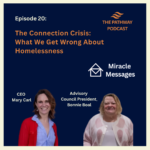




In this episode, Sarah sits down with Mary Carl, Chief Executive Officer of Miracle Messages, and Bonnie Boal, President of the Miracle Messages Advisory Council, to explore how human connection, not just housing, lies at the heart of solving homelessness. Together, they make the case that “relational poverty” is a deadly and often-overlooked force that keeps people unhoused, and that rebuilding social support systems is as essential as a roof overhead. Mary shares how Miracle Messages has reunited over 1,000 unhoused neighbors with their loved ones, facilitated more than 277,000 minutes of conversation between volunteers and unhoused neighbors through its Miracle Friends phone buddy program, and distributed over $1.1 million in direct cash assistance through Miracle Money. Bonnie brings the conversation to life with her own story of eight years of navigating homelessness across multiple states before finding stable housing and speaks candidly about the isolation, the paperwork, the stigma, and the moment a Miracle Friend named Hannah changed everything. The conversation also examines what gaps remain in the system, from mental health resources to credit-building support, and why lived experience must be at the center of any solution.
About Our Guests
Mary Carl is the Chief Executive Officer of Miracle Messages, an award-winning nonprofit that helps people experiencing homelessness rebuild their social support systems through family reunification, volunteer companionship, and direct cash assistance. Mary has spent over two decades in the nonprofit sector working on issues of equity, homelessness, and health. Before joining Miracle Messages, she served as Executive Director of California at Health Leads, working closely with community partners, local public health departments, and healthcare systems. Before that, she was Director of Programs at Building Opportunities for Self-Sufficiency, a leading homeless service provider in Alameda County, California. Mary began her career supporting individuals with intellectual disabilities and mental illness. She currently sits on the Board of Directors for Courageous Women and serves as Treasurer of the Board of Directors for the Ability Challenge. She holds a Master of Health Care Delivery Sciences from Dartmouth College, a Master of Public Health from the University of North Carolina, and a Bachelor of Arts from the State University at Buffalo.
Bonnie Boal is the President of the Miracle Messages Advisory Council (MMAC). A native Californian now settled in San Francisco, Bonnie’s life took her through marriage, college, motherhood, owning a catering business, and homeownership, and also through being unhoused off and on for over eight years. She reminds us that housing instability is a reality that can happen to anyone. Now 69, Bonnie lives in a beautiful studio with her service dog Biscotti and has been housed for nearly three years. She credits the support of many friends and organizations, especially Miracle Messages, for helping her reach stability, and she is grateful for the opportunity to give back to those who once helped her.
Transcript
Mary Carl (00:00):
Homelessness is not just a housing crisis, but it’s a connection crisis.
Bonnie Boal (00:05):
There is a path out of homelessness. It’s not going to be quick and easy, but it is possible.
Sarah Johnson (00:16):
Welcome to the Pathway Podcast. I’m your host, Sarah Johnson, and thank you for joining us for this episode. Pathway to Tomorrow is a nonprofit with initiatives in housing, environmental conservation, and water security. In this podcast series, we engage with leaders working on solving some of the world’s most challenging problems by exploring innovative solutions being implemented by leading NGOs, nonprofits, think tanks, companies, and institutions focused on issues like homelessness, equitable philanthropy, environmental conservation, climate change, and water security.
Sarah Johnson (00:43):
Our guests today are Mary Carl and Bonnie Boal.
Mary Carl is the Chief Executive Officer of Miracle Messages, a nonprofit organization dedicated to addressing homelessness through human connection, family reunification, and direct support. Mary’s work focuses on restoring dignity and rebuilding social networks for individuals experiencing homelessness, challenging traditional approaches by emphasizing relationships as a pathway to stability.
Through Miracle Messages, Mary has pioneered programs that reconnect unhoused individuals with loved ones, facilitate ongoing volunteer companionship, and provide direct financial assistance through initiatives like Miracle Money. Her work highlights how trust-based, community-centered interventions can complement existing systems of care and create more sustainable pathways out of homelessness. Mary’s approach has contributed to broader conversations around housing security, social equity, and the role of direct cash assistance in addressing systemic inequality.
By centering lived experience and human connection, her work offers a compelling model for how nonprofits and communities can rethink solutions to one of the most pressing social challenges of our time. Bonnie Boal is the President of the Miracle Messages Advisory Council. A native Californian, now settled in San Francisco, Bonnie’s life journey has taken her through marriage, college, motherhood, owning a catering business, homeownership, and also through being unhoused off and on for over eight years.
She reminds us that housing instability is a reality that can happen to anyone. Now seventy, Bonnie lives in a beautiful studio with her service dog Biscotti and has been stably housed for nearly four years. She credits the support of many friends and organizations, especially Miracle Messages, for helping her reach stability, and she is grateful for the opportunity to give back to those who once helped her. Mary and Bonnie, it’s so wonderful to have you on today. Thank you so much to both of you for joining us.
Mary Carl (02:33):
Thank you for having us.
Bonnie Boal (02:36):
Thank you.
Sarah Johnson (02:37):
Mary, to start us off, can you tell us the origin story behind Miracle Messages and what inspired the creation of this model?
Mary Carl (02:44):
Yes. So a little over eleven years ago, our founder, Kevin F. Adler, was inspired due to his uncle, who was facing homelessness for years around Santa Cruz, to really understand what it was like for people to navigate through homelessness. And at the time, he had individuals who were residing on the streets in San Francisco wear GoPro packs so they could start to identify what their experiences were while living on the streets. And it was through those films that were being captured that it was identified that individuals really didn’t understand when they lost their housing, but really it was the loss of friends and family that made them really identify the homelessness that they were experiencing. And through that footage and the experience of people who were residing on the street, that’s where Miracle Messages started from.
And it was one individual that we worked with initially in locating their family and friends, and it was through, at that time, Facebook, and we were able to help support somebody connecting with their family and loved ones that they had been disconnected with for years. And over the journey of the past eleven years, we’ve been really able to continue to enhance and develop our programs to meet the needs of our unhoused neighbors.
Sarah Johnson (04:11):
Thank you for sharing that, Mary. Such a compelling story, and something that a lot of folks probably don’t think about. You mentioned that the person didn’t realize they were homeless until the loss of family and friends. So my next question is for Bonnie. Bonnie, you’ve experienced homelessness firsthand for over eight years before finding stable housing. Can you share what that journey was like and what role Miracle Messages played in helping you reach where you are today?
Bonnie Boal (04:40):
Of course. It was definitely a journey. All it takes, I’ve discovered, is one short, really rotten marriage to cause a person to lose everything — their housing, their stability, their possessions, everything. It started for me during a short-lived period in Texas. And then I ended up back in Iowa, which is where I was living with my second husband and my children for a long time. Then I went to Georgia and stayed with a friend of mine and ended up getting an apartment. My car was stolen there. Then my biological half-sister persuaded me to come back to California and live in Santa Rosa with her, but all she really wanted was a whole lot of money and no kindness was offered.
Then I ended up back in San Francisco, which is really a fantastic place to be. I lived in four different shelters and then in what I call the Mouse Hotel. That was a hotel on Market Street that used to be San Francisco City Hall, and it was so infested with mice that every morning my dog would have played with one and then when it died, she’d lay it out on her dog bed. It was a little rough there.
I lived in a nursing home for a while after surgery. Then they took on new management and booted me to a hotel, which didn’t give me very much time there. I was hauling my stuff everywhere. I had a storage unit which was very expensive and very hard to get in and out of.
The shelters were not fun. I’m grateful that they were there, but there were some really nasty, troubled people living there. And there were also some people who are now long-term friends of mine. It was very, very difficult. But one thing that I thought was particularly interesting — I’m about as white as you can get, very waspy, and I had racism directed at me, which was a very different experience for me. It was tough to resolve that, but it did teach me some valuable lessons about what other people are going through. All of this was a learning experience, but it’s easier to think of it that way in retrospect than it was before.
I was connected with Miracle Messages during my last place that I stayed in the homeless adventure — the hotel with the mice — and my first thing was that I got my Miracle Friend, Hannah. Hannah and I are still very close friends. We text or call all the time. She is just finishing her first semester in law school and we are very, very close. I just love her. She’s been out here a couple of times. In fact, she flew out here last year just to spend my birthday with me, which was so lovely.
But having her began my journey to normalization, because nothing felt normal about the experience of being homeless. I was invited to my first Miracle Messages Gala, which was extremely normalizing and fun and it was an excuse to get dressed up. I’ve met so many lovely people through this organization. I’ve been able to volunteer and help and take on some responsibilities that actually make a difference to me and to the universe and to other people. Miracle Messages has helped financially, they’ve helped socially, and the biggest connection that I had was with Hannah. They just seem to understand and know the best things to do to help the whole journey back to being housed again work better. So I’m extremely, extremely grateful to them. And the people are just wonderful, including Mary.
Sarah Johnson (09:12):
Thank you so much for sharing your journey, Bonnie. It was just such a beautiful story, and so encouraging and so hopeful to hear about the folks like your person Hannah, who I believe you said was a volunteer with Miracle Messages.
Bonnie Boal (09:28):
She’s my Miracle Friend.
Sarah Johnson (09:30):
So beautiful, the role that she played, and it sounds like continues to play, in your journey.
So my next question is back to Mary. Mary, your work emphasizes human connection as a core intervention, which we experienced through Bonnie’s story. Thank you again so much, Bonnie, for sharing more on your story. Can you both talk about why relationship building and companionship are so central to addressing homelessness and how Miracle Messages operationalizes that in practice?
Mary Carl (9:57):
Yes. So our organization is really looking at the importance of being in community with each other. I believe that homelessness is not just a housing crisis, but it’s a connection crisis. And the lack of human connections impacts our ability to create health and wellness, and we have seen through research that it also impacts one’s physical, emotional, and housing and financial sustainability. And so I think that is incredibly important for us, both in the immediate but also the long-term success.
And so there are two components to our organization, two parts to our mission. One is so that nobody experiences homelessness alone. And the other component is that nobody feels helpless around the issue. And so our organization is really looking at activating and involving our housed community members to be a part of the solution, which I think Bonnie so graciously just described in her relationship with her volunteer Miracle Friend connection.
And so we look at activating volunteers across the country to support three core components of our work. Our reunion program, which is connecting loved ones — both friends and family that have been disconnected with each other — our digital detectives volunteer and help support that. We have our Miracle Friend program, which is connecting volunteer housed community members with our unhoused neighbors, where they connect with each other virtually through phone calls, text messages, and like Bonnie just described, also in some situations they’re able to physically see each other. And some of those relationships last a few months and some of them last years. And then the third part of our organization is around our Miracle Money program, and that’s where we provide cash assistance to individuals. And through these programs we’re able to activate and support both our housed and our unhoused community members in being in relationship with each other.
Sarah Johnson (12:08):
Thank you for sharing more on that, Mary. And Bonnie, was there anything that you wanted to add with regard to the importance of relationship building and companionship?
Bonnie Boal (12:16):
When I became homeless, I lost several of my very close friends. A couple of them had been my friends all my life. It was like they broke up with me — maybe they thought this was contagious, I don’t know — but it was very, very hurtful. My two sons, who are now in their thirties, really struggled with their mother being unhoused, and they were living in different parts of the country, so it was hard for us to see each other. And they really, really struggled with that.
I do have two very close friends who hung in there with me through the whole thing. I call them my two Kathys. One of them I’ve known since I was five years old, and she lives here in California. My other Kathy lives in Iowa, where I lived for quite a while. And they have stayed in touch with me, kept connected with me, and helped me out whenever they could, financially and emotionally. That whole connection thing is so vital. It’s vital for the support, for the sense of normalcy, for the solutions they can help out with. There are just so many reasons why we really, really need friends, we need people who care about us. And it’s painful when you lose somebody forever because of being in this situation, but you can recover, and Miracle Messages helped a lot with that in sending me Hannah. And I also have to give credit to my two Kathys as well.
Sarah Johnson (13:52):
Thank you for sharing that, Bonnie. So helpful to hear that additional detail. As humans, we’re social creatures. No man is an island, and so it is so critical. And I think a lot of people don’t think about that loss of connection being such a huge part of the road back to becoming housed.
So my next question is for Mary. You did touch on it a bit in my last question, but I would like to hear more about your Miracle Money program. It’s one of your most innovative programs, which combines direct cash transfers with social support. How was this model designed and what outcomes have you seen so far? And then for Bonnie, if you could tell us a bit more about whether direct financial assistance played a role in your path to stability.
Mary Carl (14:42):
Yeah, the Miracle Money program is definitely a very key and important part of our organization. We really believe in the importance of having local service providers supporting individuals, having relationships and interconnectedness, and also supporting the financial sustainability of our community in order to help support them moving out of homelessness and then remaining out of homelessness long term.
And so around five years ago, after we had been hearing from our unhoused neighbors and our volunteers how much money was impacting the ability to really develop and spend time and focus on the relationships — because of the financial strain that people were experiencing — we had the opportunity to explore what it would look like for us to pilot small cash transfers. And at the time, it was a six-month pilot that we did with fourteen individuals, and we were able to provide them with $500. And during that initial pilot, we saw some very successful impacts from those individuals moving into housing.
And so we were able to expand on that, both in the San Francisco, Oakland, and LA area, and were able to complete a randomized control trial with the University of Southern California Social Work Department. And through that, we were able to look at the impacts of a cash-plus approach, and we were able to see some really important success and impact from the work. And it also left us some space to continue to question and understand how we can be more effective and really understand the impact of the cash assistance.
And so now we are just finishing another program in cash distribution with our Miracle Money program, where we’ve been partnering very closely with nonprofit organizations in California and really looking at how that theory of change — of local service providers, plus social relationships, plus cash — helps support people in their health, their wellness, their housing, transportation, and food security. We’re still in the process of understanding and surfacing the impact of the work and we’ll have the final results from that later on this year.
But I would say, over the past five years, we’ve been able to identify that money — basic income — helps alleviate poverty. And so basic income is a key component to reducing the burden that people are experiencing. And we’ve also been able to identify that the more touch points that people have, in addition to the basic income, we are starting to see stronger success in their outcomes across the different domains: health, transportation, housing security, and financial savings. And so we’re really excited to start to see some of those early results.
And then the other piece that is often asked, as we’re talking about homelessness and basic income, is that we have also been able to start to show — both through the randomized control trial and continuing to see this amplified and proven — that the money being utilized by individuals in unstable housing situations has been going toward basic needs such as food, housing assistance, and transportation. And we’ve actually seen a decrease in substance use, alcohol and drugs. And so it’s been important, I think, to start to break down some of that narrative and some of those misbeliefs around how people, if they are living on the streets or in insecure housing situations, would utilize their cash assistance.
Sarah Johnson (19:10):
Thank you for sharing more on that, Mary. It’s really interesting to hear about that randomized control study and also the evidence that it uncovered around the role — or maybe not so much the role — that substance abuse plays in the lives of those who are unhoused. You mentioned that through receiving cash assistance, you found that participants were less likely to engage in substance use, and I think something that we need to have more studies around is the huge misperception around that element of the unhoused population and what the experience is really like.
So thank you for sharing that, Mary, and I’m really looking forward to hearing more on that study that you mentioned will be released later on this year. So my next question builds on a lot of what you were talking about, Mary. Many organizations struggle to connect short-term support with long-term housing stability, and again, because of the misperceptions that exist around the daily realities of those who are unhoused. How does Miracle Messages collaborate with other service providers or systems to help individuals transition into stable housing?
Mary Carl (20:31):
Yeah, our work is really in partnership with local service providers and local continuum of care within the homeless service safety net. And so we partner with organizations by providing our volunteer support to community members that they’re serving who would like additional relational support — whether it’s reunification or our Miracle Friend program. And so in some situations we have volunteers who are embedded within the local service provider organizations that are doing outreach and enrolling people into our services. And then in other places, organizations are referring directly to us to support individuals in continuing to get their long-term relational supports amplified and solidified.
And I think one of the things that is really important about the work that we do in partnership with a lot of nonprofits supporting homeless services is that a lot of those nonprofit organizations are providing, you know, sometimes between three months to eighteen months of services to individuals, and really looking at providing comprehensive services. But where everybody is often a paid professional supporting the community, I think what’s really important is that our work is volunteer-based. So it’s really just people getting to know people. And we’re not time-bound, which I think is really important. We’re able to work with people for as long as both the individual navigating into and out of homelessness wants to be in relationship with the community, and also as long as our volunteers, which has allowed some of these relationships to be five-plus years, where they are in a friendship with each other.
And so I think that’s just a really important differentiation, and an important piece that we want to continue to amplify. It’s a nice add-on support to the important local services that are being provided by nonprofits that are able to provide more of those acute specialized needs that individuals are experiencing.
Sarah Johnson (22:52):
That’s wonderful. And just a follow-up on some of what you shared — are some of the studies you mentioned, that you’ve done in the past and the one coming out later, exploring the interlinkages between the work that Miracle Messages is doing, whether it’s connecting with family or relationship building and connection to these other supportive services? How do those all work together and play equally significant roles in getting an individual back on the path to being housed?
Mary Carl (23:24):
Yeah, that’s a great question, Sarah. In the more recent study that we’re doing, where we are looking at local service providers plus our services plus the Miracle Money program, that’s where we really started to see that correlation between relationship touch points and housing outcomes and improved outcomes for those individuals. And as we continue to study and research and understand the impact of our work, the next phase is really going to get at the question a little bit more nuanced — like when we look at those relationship touch points, what of that is the volunteer friendship, the case management support — and kind of get into a little bit more nuanced information about what that means. So we’ll have more information at a later point about whether it’s the number of case management support sessions plus relationship volunteer support, plus community support that helps people in their long-term success.
Sarah Johnson (24:32):
Thank you for sharing that, Mary. I’m really interested in learning more. I think it’ll be something that is just really insightful and formative for those wanting to understand how we get to the bottom of and help solve the challenges faced by our unhoused population.
So my next question centers around the theme of our season at the Pathway Podcast — equity is a major theme as we enter our third season. This question is for both Mary and Bonnie. How do you ensure that your programs are meeting the needs of the most marginalized communities within the unhoused population? And a question specifically for Bonnie — from your own experience, what gaps in service did you notice that you feel are still under-addressed within the ecosystem of organizations working to support those who are unhoused in getting back on the path to becoming housed?
Bonnie Boal (25:23):
That’s a really, really interesting question. I had a lot of fun thinking about that. In general, I think there needs to be a lot more mental health help. The solutions are not enough right now. When someone has what they call a breakdown, they’re only given three days in a mental health facility and then left to fend for themselves, and that’s not particularly helpful. And obviously more solutions, more treatment for drug problems, which address the hopelessness that leads people to become addicted — they just need more. They’ll probably always need more, but they really need more right now.
For myself, I felt very lucky to have some background in business. What I learned in college and in my different jobs was how to keep a calendar, how to plan things, how to complete paperwork — but there is so much of that that’s necessary when you’re navigating the system and trying to get housing. There were times when I felt like I really needed a secretary to keep track of all the papers I was filling out, the appointments I needed to make, the phone calls I needed to make. I mean, it’s a lot. And it’s really a lot if you’re in a shelter and you’re going back and forth and you have to be out for several hours every day.
So that kind of helped — just teaching people how you run your life, how you organize things — and this is the first place where that becomes really necessary. I took a fantastic class right after I got my housing that’s available in San Francisco. It’s called Smart Money, and it helps people learn about how to handle their money. It’s everything from keeping a checkbook to availing themselves of all the free services that are available in the city, and how to build a credit score again. I don’t have bad credit, I have no credit, and their tips have been really helpful in telling me how I can reestablish that, which seems to be pretty important in our society. Those are the two things that I felt the most — the time management and the money management and the paperwork management — those are the gaps that I would like to see filled.
Sarah Johnson (28:10):
Thank you for sharing that, Bonnie. So many really great insights there. It sounds like it was unnecessarily complex, or there was maybe overlap in terms of all the paperwork and the appointments that need to be scheduled — so the need for support through that process. And then as you mentioned, and I’ve heard this as a recurring theme, the help with building a credit history, because it’s so crucial to being housed. Those two things really stand out in your answer. I really appreciate that level of detail and insight.
And Mary, if we could go back to the first part of this question — how does Miracle Messages ensure that your programs are meeting the needs of the most marginalized communities within the unhoused population?
Mary Carl (29:00):
Yeah. So our organization, as I described in the very beginning about where we came from and how we built our organization, it’s been from the onset really about hearing from people what they are needing and developing programs and understanding the impact of the program through that lens. And so we also remain scoped, right? So we’re really clear on what we do and how we partner with other organizations who can maybe fill other gaps that we aren’t able to provide. And so I think having that clarity and hearing directly from people with lived experience allows for us to continue to understand who we are, what the impact of our work is, and who we might not be as effective in meeting the needs of.
The other piece that we are continuing to enhance and look at is quantitative and qualitative feedback from individuals — both looking at the impact of our work across different demographics and different components of the community that we’re serving, and then also the qualitative survey feedback and user feedback from our services.
And I will say that our organization is predominantly virtual — we provide virtual supports, and our services are often provided through phone or some kind of technology. And so there is a limit in that some within the unhoused community might not be able to access our services or have to come in and out of utilizing our services because of the challenge that many of our unhoused neighbors face with maintaining consistent cell phone use. And so we are continuously looking at how we crack that really important barrier in serving a larger part of our unhoused neighbor community.
And then the other piece I would add is that Bonnie, as she mentioned earlier, is the President of our Miracle Messages Advisory Council. We established a lived experience advisory council about a little over a year ago within our organization, and this incredible group of individuals help to inform and direct some of the work that we are doing at the organizational level, both at the programmatic services strategy and how we are engaging on all aspects of our work. And so I think that also continues to allow for us to be really looking at the work through multiple different lenses around the equitable practices that we have as an organization.
Sarah Johnson (31:52):
Thank you for sharing that, Mary. So many interesting insights there as well. I hear access to technology and access to communications, which sound like two things that should reasonably be able to be addressed by contributions from various companies, or through some of the public funding that’s allocated for those who are unhoused. But this isn’t the first time I’m hearing about access to communication as a challenge, and so that’s a really interesting insight.
And to your point about having people with lived experience advising or informing the work that you do — it’s so critical, and I think it’s a major differentiator in the model that Miracle Messages is employing, which I really appreciate.
So to close, I’d love to ask you both: what gives you the most optimism about the future of community-based solutions to homelessness and housing insecurity? And Bonnie, as someone who now gives back through your role at Miracle Messages as President of its Advisory Council, what message would you most want people to hear, or most want to leave us with?
Bonnie Boal (33:06):
Well, I guess the first thing would be that there is a path out of homelessness. It’s not going to be quick and easy, but it is possible. And because of organizations like Miracle Messages and, frankly, the city of San Francisco, it is possible. And having somebody — a Miracle Friend in my case — to sort of hold your hand while you go through it makes a huge, huge difference.
There are lots of things that make me optimistic. There’s more housing being built all the time here for people who are low income, and there’s lots of help with subsidizing that so that you can afford it. The joke is that to live here, you have to either be really rich or really old and poor, and then you can get help, which is just such a blessing.
There are organizations like Homebridge, which in my case provides people who come in and help me with household chores because I am disabled, and provide a lot of support through that. And I think another thing is that podcasts like this, and any information that we can put out about who is homeless and what this is really like, makes a huge difference. I remember when I was homeless, people often didn’t believe that I was homeless because I don’t fit really any of the stereotypes about homelessness. And I actually found that kind of offensive, because it’s just a reality for a lot of people. Things like this are great for educating the public and removing the many, many stereotypes of what homelessness is. So that’s very important to me.
Sarah Johnson (35:03):
Absolutely. Thank you so much for sharing that, Bonnie.
Bonnie Boal (35:06):
Thank you for doing this.
Sarah Johnson (35:08):
And thank you for joining us. We wouldn’t have these insights without your input. I really feel that’s been a recurring theme — the importance of really rethinking how we think about the unhoused population, because it’s not necessarily a label or a category so much as just a set of circumstances that can happen to any one of us at any time. And so making that connection for folks through conversations like this, and through the work that organizations like Miracle Messages does in amplifying that work and creating space to talk about it and why it’s important. Mary, is there anything that you’d like to add there?
Mary Carl (35:49):
Yeah, I mean, I feel like every day I come into work I’m just reminded how good people are. But I think that over the past couple of years, I’ve been really surprised and excited that our work is really contingent on volunteers raising their hands and identifying that they want to bring Miracle Messages into their community and they want to be in a different relationship with their unhoused neighbors. And it’s been overwhelming, the number of people who’ve reached out to us to do exactly that. And across communities all across the country — anything from Burlington, Vermont, to Fort Worth, Texas, to Eugene, Oregon, to Appleton, Wisconsin. It’s been fascinating and exciting and it just makes me feel like people are wanting something different and they’re wanting this to look different. And that gives me hope for the future.
Sarah Johnson (36:49):
Absolutely. Thank you so much for sharing that, Mary. I’m leaving this conversation very hopeful as well, just hearing about volunteers like Hannah and the role that she continues to play in Bonnie’s life. It really is encouraging and gives me a lot of hope and makes me feel optimistic about our ability to reach a place where we have a zero number of folks who are unhoused.
So thank you so much again to both of you for joining us, Mary and Bonnie. It’s been a true pleasure to learn more about your work and to hear both the organizational perspective and the lived experience of what human connection, trust, and community-based support can mean for someone navigating being unhoused. From reconnecting individuals with loved ones to pioneering innovative approaches like direct cash assistance, to the powerful example that Bonnie sets in joining us here today and giving back to the community that helped her — your work together offers an important and deeply human perspective on how we can build more equitable and effective systems of support.
To our listeners, thank you for tuning in and don’t forget to subscribe to the Pathway Podcast to get alerts on new episodes featuring thought leaders working in housing, environmental conservation, climate change, and water security. Thank you both again for joining us today.
Bonnie Boal (38:05):
Thank you, Sarah.
Mary Carl (38:07):
Thank you.